
LIVE UPDATES
Echoes of the Prairie

Here is where you will find written scripts and bonus information for episodes of Echoes of the Prairie.
Echoes of the Prairie features the history of places in TSPR's broadcast region. Echoes of the Prairie airs Tuesday - Friday at 8:19 am and 5:48 pm. Each episode features content created and recorded by local residents. For more information about the program's content contributors please visit the show's home page.
Macomb; 1941 Fire at Macomb Motors

Celebrating Macomb Week!
On June 24th of 1941, the Macomb Daily Journal reported a dramatic fire at the Macomb Motor Company building at Lafayette and Washington Streets. Many in Macomb already knew the news because crowds of residents had gathered to watch the flames and help fight the blaze. One of the owners, James Trapp, discovered the fire after two boys ran from the garage to warn him.
Phone lines were damaged, delaying the call to the fire department, and confusion over which Ford garage was burning slowed the response. Flames shot twenty feet from the windows as paint and oil cans exploded, and fire departments from Bushnell and Colchester were called to assist. The fire raged for more than an hour, causing an estimated $36,000 in damage, but remarkably, only one worker was slightly injured.
By the end of the year, the building was rebuilt and doubled in size, and today it still stands at 201 South Lafayette Street. Now home to the Western Illinois Museum, it preserves both its own story and the history of the community, serving as a lasting reminder of Macomb’s resilience and determination.
The episode was written and voiced by Sue Scott.
Macomb; Caroline Grote

Celebrating Macomb Week!
No woman shaped Western Illinois University’s early years more than Caroline Grote. Born in 1863, she spent 56 years in education, breaking barriers as Illinois’ first female county superintendent.
In 1906, when Bayliss was president of Western Illinois State Teachers College, he hired Carolyn Grote to train school teachers. But she also advocated for improving conditions in rural schools. In one report, she noted that many schools had windows that “were seldom washed,” and outhouses that were deplorable. School libraries were often inadequate and not suited to the needs of the students.
Grote’s career took a new turn in 1908 when she became the Dean of Women and supervised the women students. One rule she upheld was that “every modern girl should have a chaperone.”
Even at 69, Caroline Grote never stopped learning, earning a doctorate from Columbia University. She retired in 1935, and to honor her impact, WIU renamed Monroe Hall to Grote Hall, ensuring her legacy lives on.
The episode was written and voiced by Sue Scott.
Macomb; Life of Al Sears

Celebrating Macomb Week!
On February 21st, 1910, a baby boy was born on East Adams Street in Macomb, Illinois.
His name was Albert Omega Sears. The world would come to know him as "Big Al."
He was the eighth child of Martha and John Sears — a minister — and he grew up on Macomb's East Side. It was a close-knit Black community, anchored by church and family, and cared for by Macomb's first female doctor, Elizabeth Miner. In fact, it's her signature on Al's birth certificate.
By age fifteen, Al was playing alongside jazz greats Fats Waller and Alberta Hunter. By 1927, he was in New York City — hired by Chick Webb to play the legendary Savoy Ballroom. His reputation grew. Soon, he was playing tenor sax in the elite company of Duke Ellington's orchestra — a career-defining chapter.
Then came the war. Al Sears was chosen to lead an all-star USO band — with Lester Young at his side. Segregation still shaped where Black musicians could perform. But their music broke through anyway... helping pave the way toward a more integrated military, and a more integrated America.
By the 1950s, Al Sears was doing it again — bridging jazz and a brand-new sound: rock and roll. He performed in Alan Freed's groundbreaking, integrated stage shows. And he composed "Castle Rock" — a song that became a jukebox sensation, blending swing and blues into something entirely new. Al didn't just play the music. He protected it. He founded Sylvia Music Company — named for his daughter — giving artists like himself more control over their own work.
Al Sears passed away in New York City in 1990. But his legacy remains — preserved at the Smithsonian, honored by the Rock and Roll Hall of Fame, and celebrated each year at a music festival right here in Macomb. Beyond those accolades, he's remembered by everyone who ever heard "Big Al" make a room feel bigger — and everyone in it feel welcome. From Macomb's East Side... to the world's biggest stages.
The episode was written and voiced by Sue Scott.
Macomb; 1921 Game of the Year

Celebrating Macomb Week!
On September 11, 1921, more than 1,600 people crowded into the Macomb Fairgrounds for what newspapers would later call the “Game of the Year.” The fierce baseball rivalry between Macomb and Colchester had reached its final showdown, with the series tied two games apiece and local bragging rights on the line. Fans arrived early, wagers circulated through the crowd, and excitement ran high.
But before the first pitch was even thrown, controversy exploded. Colchester had recruited three former members of the infamous Chicago White Sox connected to the Black Sox scandal—Shoeless Joe Jackson, Eddie Cicotte, and Swede Risberg. They were among the eight players accused of throwing the 1919 World Series Game, and while acquitted in 1921, they were banned for life from playing Major League Baseball. Their appearance stunned spectators and immediately raised questions about fairness and gambling.
At the center of local rumors was Henry “Kelly” Wagle, a Colchester businessman, baseball enthusiast, and bootlegger. One story claims Wagle met Jackson at a pool hall near Chicago and helped arrange for the former major leaguers to come to Macomb. During Prohibition, bootlegging money and underground gambling networks flowed through communities large and small, making such arrangements possible.
Despite protests from Macomb fans, the game continued. Cicotte dominated on the mound, Jackson dazzled the crowd, and Colchester shut out Macomb 5–0, securing bragging rights for at least one year. Yet, long after the final out, people were left debating not just who won—but whether the game had truly been fair.
The episode was written and voiced by Sue Scott.
Keokuk; Medical College

Celebrating Keokuk Week!
A December 1850 medical journal announced exciting news: a building was being completed in the 200 block of Palean Street to house the College of Physicians and Surgeons of Iowa University.
In 1857, another medical college opened at Fifth and Concert but became the Lee County Courthouse just two years later. In 1858, a new facility on North Sixth near today’s Grand Theater joined the city’s growing roster of medical institutions.
The Civil War expanded Keokuk’s medical services, with 1,350 beds across sites like the Estes, Leighton, Simpson, and Deming Houses, Rice Hall, Central School House, and medical college buildings. Students and doctors treated thousands of wounded and ill patients.
In 1890, another building opened at Seventh and Blondeau, offering general and specialized medical courses with an amphitheater for 300. The first class graduated 63 men and women in 1891.
Keokuk Medical College and the College of Physicians and Surgeons operated as rivals until merging in 1899. They joined with Keokuk Dental College in 1897 and a pharmacy college in 1900. In 1908, they became part of Drake University and merged again in 1913 with the State University of Iowa, ending Keokuk’s era as a leader in medical education.
The episode was written and voiced by Angela Gates.
Keokuk; Knight Auto

Celebrating Keokuk Week!
Keokuk’s first automobile was reportedly purchased by Dr. C. E. Ruth, a surgeon at St. Joseph’s hospital. It could carry two passengers, though it often failed to carry any.
Soon after, electrician Frank Knight rolled out a homemade car. Though odd in appearance, it was practical—except on steep hills. His three-wheeled, box-like vehicle resembled a large tricycle, with front-wheel steering and a carriage-style seat above the rear wheels.
Knight, a brilliant scientist and mechanic, used the car for many years. After his death in 1938, his estate funded a redesign of the children’s room at the Keokuk Public Library. His bright yellow, single-cylinder, water-cooled car was displayed there until 1972, when it was driven in Keokuk’s 125th jubilee. It then returned to the library and remained on display until 2005, when it was loaned to the Spaulding Center for Transportation.
Today, Frank Knight’s unique automobile is housed at the Antique Car Museum of Iowa in Coralville.
The episode was written and voiced by Angela Gates.
Keokuk; Library

Celebrating Keokuk Week!
1863, renewed efforts succeeded—funds were raised, bylaws adopted, and the Keokuk Library Association was established.
The library opened June 1, 1864 at 80 Main Street, with 185 members and over 2,500 items. Within a year, it expanded into adjacent space over a local bank was open from 2 to 10 PM.
In 1879, an endowment from the estate of Judge J. L. Rice enabled the library to secure its own building. The newly constructed library at 3rd and Main opened in 1883, with rental shops below and the library above.
An election in 1894 meant the city would take ownership of the association and its services, and the Keokuk Public Library was born. The library at 3rd and Main continued until a brighter and more accessible space was desired. This led to the construction of a new building: the library in the round.
The current library building opened in 1962 at 210 North 5th Street, with over 300 checkouts reported on opening day. It continues to grow and evolve, honoring a tradition which began more than 160 years ago.
The episode was written and voiced by Angela Gates.
Keokuk; Hubingers

Celebrating Keokuk Week!
Keokuk, Iowa once thrived as a center for diverse manufacturing of consumer-ready goods - producing items like food, medicine, clothing, and beer.
One of its largest operations was Hubinger's "Quick Elastic Starch,” a globally popular household item. Hubinger's became an economic force in Keokuk for over a century.
Though originally met with skepticism, John Carl Hubinger was convinced (and managed to convince others) that his product was the best of the best. And it worked.
Hubinger became incredibly wealthy as a result of his business enterprises. His lavish mansion at 1229 Grand Avenue spanned 7 blocks on both sides of the street. He funded an electric plant as well as a telephone exchange which could reach Minnesota.
Hubinger was a champion for sports, arts, and modernization. He established Pastime Park for the enjoyment of the public, funded an electric power plant,a and provided the city with the nation’s first electric streetcar system. Two lawsuits spelled the beginning of the end for Hubinger’s empire. As his fortune dwindled, he moved to a boarding house at 616 High Street and died there in 1908. His mansion was demolished in 1928.
His company survived and changed over the century and now operates as Roquette America.
The episode was written and voiced by Angela Gates.
Monmouth; Wyatt Earp

Celebrating Monmouth Week!
In the quiet heart of Monmouth, Illinois, stands a modest white house with green shutters. It’s the Pike-Sheldon House. At first glance, it looks like any other 19th-century home, but in 1848, it became the birthplace of one of America’s most legendary lawmen: Wyatt Earp.
Before the dusty streets of Dodge City and the gunfight at the O.K. Corral made him a frontier icon, Wyatt Berry Stapp Earp was just a boy growing up among the rolling prairies of western Illinois. His family’s home right in Monmouth still stands as one of the few places where visitors can literally walk in the footsteps of the man who would help define the Wild West. Wyatt Earp is a Monmouth son of the Heartland who became a national figure for his role in taming western frontier towns.
The Pike-Sheldon House isn’t just a birthplace, it is a time capsule. Its simple wooden frame has seen the growth of a nation, the movement of pioneers, and the rise of a legend whose name would echo from Illinois to Arizona and beyond.
Today, Monmouth honors that connection. It is a small Midwestern town that helped shape a larger-than-life American story. The Wyatt Earp Birthplace draws visitors, historians, and Old West enthusiasts from across the country.
Often heroes of the Wild West came from small, hardworking Midwestern communities. Because before he was a lawman and a legend, Wyatt Earp was one of Monmouth’s own.
The episode was written by Ann Tenold and voiced by Tom Best.
Monmouth; One Room School Houses

Celebrating Monmouth Week!
Back in the day, long before yellow buses rattled down rural roads, much of the schooling in Warren County happened in humble one-room buildings scattered across the countryside.
In 1854, a small village was laid out amid rolling farmland in Warren County. In 1866, just a dozen years after the town of Kirkwood (then called Young America) was founded, the village’s “official” school was built. It was called the “Old South School”.
But beyond the village, 1878-era records show that rural Warren County was dotted with dozens of these “country schools” One room, wood framed — serving farming families spread across the countryside. By some counts, there were well over a hundred ungraded schoolhouses in the county. Inside one of those country schools, a single teacher would ring a bell to start class, gather students around a pot-bellied stove for warmth in winter, call out spelling lessons or arithmetic problems, lead recitations of history or scripture.
The Old South School hosted spelling bees, evening programs, and town gatherings. The one room serving as Kirkwood’s classroom, meeting hall, and social center all at once.
As Kirkwood grew with the railroad arriving, new families settled in and the tiny building couldn’t keep up. By the late 19th century, larger and more modern school facilities appeared, eventually replacing the original one-room schoolhouse. But that first little building on the south side of town lit the spark. It taught the first generations of Kirkwood’s students and set the foundation for the strong community the village is known for today.
In 1908 alone, Illinois still had over 10,000 rural one-room schools. These buildings remain a powerful symbol of simpler times: of multi-age classrooms, impromptu recess in open fields, community gatherings, holidays marked with potluck dinners, and a shared dedication to learning.
The episode was written by Ann Tenold and voiced by Justin Swearinger.
Oquawka/Monmouth; Elephant's Graveyard

Celebrating Monmouth Week!
The elephant's graveyard. A myth about where elephants go to die. A metaphor for a place where people or things are forgotten or lost. Draw a line through Illinois from Monmouth to Oquawka and just maybe you've found that mythical place. Or part of it. Elephants wander in and out of American history. Jefferson hoped to find them west of the Missouri. There were none. The King of Siam offered Lincoln elephants. Lincoln said no. Nizie was a male dwarf Indian elephant. Magic brought him to Monmouth. The magic of The Great Nicola, a renowned traveling magician who made Monmouth his home when he was not on the stages of the world. A gift from an Indian prince, Nizie was part of Nicola's traveling magical menagerie. Nizie grew ill in 1934, came to Monmouth for care but died in the fall and was buried forgotten in a pasture. Norma Jean was a large African elephant and main attraction of the Clark and Walter Circus. She was beloved for her gentle nature. In July of 1972, tragedy and lightning struck Norma Jean. The circus left hurriedly. Due to her size, Norma Jean was buried by the town where she fell. A search for Nizie's grave a few years ago may have found it. Norma Jean's grave is marked and celebrated by the town still.
The episode was written and voiced by Joel Ward.
Monmouth; Western Stoneware Co.

Celebrating Monmouth Week!
Welcome to Monmouth, Illinois, where a quiet patch of land once hid a discovery that would help shape an American industry. In the 1850s, as farmers tilled the soil, and more railroad tracks began laying west, a treasure beneath their feet was discovered. It’s not gold, not silver, but clay. And not just any clay. This was a rich, remarkably workable deposit perfect for pottery and stoneware.
Local entrepreneurs quickly realized what they were standing on. Word spread, kilns were built, and before long Monmouth became a hotspot for high-quality clay products. But the real breakthrough came in 1906, when several regional potteries joined forces. Their merger formed a name that would become legendary in American ceramics: Western Stoneware Company.
Western Stoneware wasn’t just making jugs and crocks. Potters were crafting the everyday vessels that fed America: butter churns, food storage jars, water coolers, and later, decorative pieces that collectors now hunt for like buried treasure.
And it all started with those extraordinary Monmouth clay beds. Raw material that ignited a company, fueled a region, and left its mark in every beautifully glazed piece of Western Stoneware.
The episode was written by Ann Tenold and voiced by Abby Zeus.
Galesburg; East Main Street

From the big Sears store across from the Post Office at Chambers Street to the banks at the Broad Street square, East Main Street in Galesburg was the place to be on busy Saturday mornings. Bev Cherney recalls her mom’s running into town from Abingdon in the 1960s: “We came in every Saturday to do our shopping”, she said. “You could get anything you needed in Galesburg.” Downtown shops sold furniture, gifts, clothing and shoes, hosiery, jewelry, typewriters and sewing machines. You could get a soda or lunch at the Woolworths. And at Christmastime “store fronts were decorated to the hilt. It was a big deal to go to Galesburg to see the displays.” The decline in downtown shops in the 1970s was the result of a perfect storm of industry automation and plant relocations coupled with the opening in 1975 of Sandburg Mall on North Henderson Street. Sears, Carsons and JC Penney moved to the mall. O.T. Johnsons closed in 1978. People started leaving the area for jobs elsewhere and those that stayed didn’t have the dollars to keep the downtown stores alive. But even as shops were leaving, new businesses were coming in. Calico Cat opened its gift shop in 1968. The Landmark Café opened in 1978. Steadily interest again grew in downtown commercial spaces. Independent shop owners started filling in downtown’s blank spaces. Storefronts filled up again with shops selling books, gifts, musical instruments, pet supplies, clothing, antiques and more. Restaurants and coffee shops became solid attractions to downtown.
Some of the stalwarts are still there. Lindstrom’s appliances and the Singer sewing shop offer a bit of nostalgia for the old days. Main Streets have up and down cycles. Today, Galesburg has enjoyed a resurgence of downtown gatherings from First Fridays to performances at the Orpheum Theatre. Main Street and the downtown area are once again vibrant destinations.
The episode was written and voiced by Karen Cates.
Oquawka's Name

I’m Rebecca Quick with the Buchanan Center for the Arts in Monmouth, and this is Echoes of the Prairie, the history of the places we call home. Before there was a town called Oquawka, there was the river.
Along the banks of the Mississippi, where the prairie met the water, Indigenous peoples had lived, traveled, hunted, and traded for generations. The river was a highway, a source of food, and a gathering place. Oquawka’s name itself carries the echoes of the people who came before. The Sauk and Meskwaki called it Oquawkiek, a name commonly translated as “Yellow Banks,” a reference to the distinctive yellow and sandy bluffs rising along the river.
For the Sauk and Meskwaki, the river was a pathway and Oquawkiek was especially well placed. Canoes could carry people along the shoreline and across the river. The water connected communities and hunting grounds, while the surrounding prairie, woodlands, and wetlands provided food and resources. Black Hawk, the Sauk leader, remembered the Yellow Banks as a stopping place along the Mississippi during journeys to and from winter camps. So when we hear the name Oquawka, we're hearing an echo from a time before the town existed.
The episode was written by Ann Tenold and voiced by Rebecca Quick.
Maquon IL; 1923 Women's Ticket

In 1923, long before Women’s Lib, a women’s ticket was presented to the voters of Maquon during the spring election and defeated the men’s ticket approximately 2 to 1.
Elected were:
Village Board President: Sarah Bearmore
Trustees: Maudie Howard, Elsie Hartsook, and Susie Simkins.
During their term in office these women shared in the efforts of raising funds to help purchase Maquon’s first fire truck which boasted a price tag of $4,580.00. And further went on to help raise the funds to house the newly purchased fire truck. Later that year, Maquon’s fire station was built at the cost of $1,523.67. Residents were serious about a volunteer fire department and fire fighting equipment other than the buckets and water in the hands of every able-bodied man who could get to a fire. 103 years later, Sarah Bearmore has been the only woman to fill the position of Mayor of Maquon.
The episode was written and voiced by Kenny Knox.
Burlington; Shorty Gamble & Jim Jordan

With the Mississippi River being right on its doorstep, Burlington favored rowing as the competition of choice in the 1870s. Many of the local businessmen formed the Burlington Boating Association’s team. And they were usually among the winners at the regattas that hosted teams from up and down the river as well as inland.
Much credit goes to Jim Jordan who built exceptional boats with both elegance and speed in mind. His racing skiffs were timed at an average 7.9 miles per hour. In 1873 a skeptic bet him that he wouldn’t be able to row the 39 miles from Burlington to Keokuk in less than six hours. He did – and he pocketed the ten dollars.
One of the best-known Burlington turn-of-the-century athletes was Shorty Gamble. The son of an Indian scout, he had moved to Burlington around 1900. Shorty achieved fame both as a bicycle racer and as a wrestler despite his five-foot-three frame. His wrestling bouts often lasted for many hours and he nearly always won. He preferred short bicycle races such as a half mile and usually won these, too. In 1901 he won the Iowa-Illinois-Missouri championship – a real Tri-States champ.
Gamble became known as an early automobile dealer, and, then, in sporting goods followed by a gun shop. Most remembered of all was the auto race against a freight train from Burlington to Chicago. Shorty won.
The episode was written by Mary Krohlow and voiced by Kara Ewinger.
Nauvoo; Dr John Weld

Dr John Weld was born in Vermont in 1808. He enrolled in Dartmouth Medical School in 1833 and came to Illinois in 1837. He first settled in St. Mary's Township and traveled the county as a country doctor. He was first called to Nauvoo to treat Hiram Kimball. In 1839 he settled in Nauvoo, opening his practice on Mulholland Street and taking up the position of surgeon to the Nauvoo Legion. Dr Weld serviced an area of 30 miles around Nauvoo often traveling by rail or carriage to visit and treat the various ailments of the residents.
He was known for his friendship and being a friend to all regardless of religion, which during that time in Nauvoo was notable. He passed away in 1892 in Nauvoo after a long life dedicated to public service. His office is now the Weld House Museum operated by the Nauvoo Historical Society where you can see his medical bag that he carried with him on his many Dr visits
The episode was written and voiced by Rebecca Williamson.
Schuyler Co. William H. Dietrich

If one crosses the bridge over the Illinois River at Beardstown, they may notice that it is named William H. Dietrich Memorial Bridge. Most people who live in the area have no idea who William H. Dietrich was?
William Henry Dietrich was born near Cooperstown, in Brown County, Illinois, in 1876. He attended college in Rushville at the Kennedy Normal School graduating in 1897 and after a stint of service in the Spanish-American War, he attended law school in Indiana finishing in 1901. He was a lawyer in Rushville and was elected city attorney from 1903-07 and county judge from 1906-10. In 1911, he left Rushville for Chicago but eventually landed back in nearby Beardstown in 1912. There he took up his practice as a lawyer.
In 1916, he ran for Representative to the General Assembly and won and did so again in 1918. After two terms he returned to the law firm. Then in 1930, the political bug drew him back, and he won election in the U.S. House of Representatives. He served one term and in 1932 ran for U.S. State Senator and also won. Dietrich only served one term as Senator from 1933-39. He returned to Beardstown and his law practice but unfortunately died in Springfield on a business trip in October of 1940. William H. Dietrich is buried in the Rushville City Cemetery.
The episode was written and voiced by Adam Wise.
Nauvoo; John Repplinger

An early character of Nauvoo in the late 1800's was John Repplinger. He came to Nauvoo from Germany with his family when he was 5 years old. John, or "Repp" as he was called, only had a third grade education, but he was an accomplished inventor. He never saw the need to patent any of his inventions, so he never received much accolade or money from them. He made the first mechanical post hole digger, first self propelled tractor, first tractor driven grape hoe, first portable saw machine, and invented cement block homes among many, many other inventions.
Repp had a garage on Mulholland Street and invented the first visible filling station in 1915. One day a man was seen sketching the five gallon glass jug on top of the gasoline pump Rep invented and that man then secured the patent for himself. Repp was not concerned with fame or fortune, he just liked to tinker and create machines to entertain himself and his Nauvoo neighbors.
The episode was written and voiced by Rebecca Williamson.
Burlington; The Hodge Brothers Hanging

In 1845, life in the Nauvoo Mormon community was in a state of flux. Their leader, Joseph Smith, had been killed in the Carthage jail the previous summer. Given its substantial population, Nauvoo had become a convenient place to hide - for thieves and criminals of all kinds.
William and Stephen Hodge, having previously lived in Burlington, were reputed to be thieves. In May of that year, the duo were alleged to have killed two men during a robbery in a cabin near West Point.
Justice came quickly. They were arrested in Nauvoo, jailed, tried, and sentenced to be hung on July 15th. Gallows were built in the ravine south of Burlington’s Mount Pleasant Street in the area which later housed Lincoln School and the Northwest Cabinet Company.
The hanging became a local entertainment for an estimated 10,000 who watched from the surrounding hillsides. William and Stephen Hodge were the first and last to be hung in Burlington.
The episode was written by Mary Krohlow and voiced by Mary Wiseman.
Schuyler Co. Larry Ball

Larry Ball was a professional football player who graduated from Rushville High School in 1967. In high school, Larry excelled in football, basketball, baseball, and track. He was offered a scholarship to play basketball at Louisville University; but after his sophomore season he switched to football. In 2001 Larry was inducted into the Louisville University Athletic Hall of Fame.
In 1972, he was drafted by the Miami Dolphins. His rookie season the Dolphins went undefeated and won the Super Bowl. Larry won a second super bowl title the following year. In 1976, Larry was part of the Tampa Bay Buccaneers expansion draft. That team did not win a game, which made Larry one of the very few to play for a winless and an undefeated team. Larry returned to Miami and retired after the 1978 season.
After football Larry served as a guidance counselor and football coach in the Dade County Schools in Miami, FL.
Larry Ball continues to support his hometown of Rushville. He has donated numerous autographed items such as footballs and pictures. Larry Ball will always serve as a reminder to athletes at Rushville that with hard work and determination a small town guy can make it in the big time.
The episode was written and voiced by Gage Utter.
Nauvoo; Sarah Grainger Kimball

Sarah Granger Kimball was born in 1818 in New York. Her family joined The Church of Jesus Christ of Latter-day Saints in 1830 and followed Joseph Smith to Kirtland, Ohio and then to Commerce, Illinois, which became Nauvoo. There Sarah met a merchant named Hiram Kimball where they were married and started their family. Hiram was not a convert to the church but Sarah wanted to contribute to the construction of the Nauvoo Temple. So after the birth of their first son, she asked for a donation to the temple construction as a present to celebrate the birth. The first meeting to organize the Relief Society was in Sarah's home in Nauvoo.
The family went to Utah with the Saints in 1851. While in Utah Sarah was the first president of the Utah Women's Suffrage Association and worked with Susan B. Anthony to gain the right to vote for women. The Kimball home has been restored and is available to tour in Nauvoo and is one of the few structures that was part of the original city of Commerce.
The episode was written by Rebecca Williamson and voiced by students of Sts. Peter and Paul Elementary School.
Schuyler Co. IDHS Correction Facility

In the 1980s and 90s Schuyler County, IL, had one of the highest unemployment rates in the state of Illinois. With this reality, the local government made constant petitions to the state to construct a prison in the county. Finally, in 1999, the state agreed to build a Juvenile Detention Facility. Governor George Ryan flew by helicopter to Rushville to make the announcement.
Shortly thereafter, construction began on the $34 million dollar facility, which was completed in 2003. The building was a 288-bed facility and it was expected to employ over 200 people. In addition, the state constructed a new water tower that was painted purple and gold to match the local school colors. However, the Juvenile Detention facility never happened and the site stood vacant for three years.
Finally, in 2005, it was agreed to make the site an Illinois Department of Human Services Treatment and Detention Facility. This program rehabilitates violent sex offenders who have already served out their sentences but are not fit to rejoin society. Since its opening in 2006, the facility has been expanded on two different occasions. Today, it houses 454 residents and provides about 250 jobs.
The episode was written and voiced by Sara Avalos.
Nauvoo; Captain James Gifford

One of the most interesting pioneers in early Nauvoo is Captain James Gifford. "Uncle Jimmy" began his career on the Mississippi River in 1847 at the age of 18 on the Nauvoo to Montrose ferry. During winter months when the river was frozen Captain Gifford would do other jobs, such as pony express rider between Oquawka and Warsaw and stage coach driver. He drove the stage coach route between Keithsburg and Nauvoo for many years, but always returned to the Mississippi River in the spring.
In 1850 he married Savilla Durfee, adopted daughter of Joseph and Emma Smith in the Mansion House. Three of their children are buried in the Smith Family Cemetery. Captain Gifford retired in 1880 and purchased property on Mormon Springs Road that he had often passed on his stagecoach route. He passed away at the age of 95 on July 4th 1924 a most interesting life well lived.
The episode was written by Rebecca Williamson and voiced by students of Sts. Peter and Paul Elementary School.
Burlington; George Harvey and Jack Kent

Burlington has produced numerous accomplished artists. Two of these, George Harvey and Jack Kent, exemplify the diversity of styles.
Today, we are still familiar with George Harvey because his massive painting of 1892 Burlington hangs in the city’s library. It had initially been displayed at Chicago’s 1893 Columbian Exposition.
Harvey’s father had come to Burlington as a cholera doctor in 1850, but young George turned his back on medicine in favor of art. After a stint in Chicago where his studio succumbed to the Great Chicago Fire of 1871, he returned to Burlington where he lived and painted for another half century. George Harvey would have achieved far more recognition had he produced his landscapes, still-lifes, and portraits in a larger city.
Jack Kent, born and raised in 20th century Burlington, turned HIS back on school, at the age of 15. During his lifetime, he illustrated numerous children’s books of his own as well as of other authors.
But his primary reputation was gained as a cartoonist. Having long been a dedicated fan of comics, he created the syndicated comic strip “King Aroo” in the mid-1900s. Often compared with Walt Kelly’s “Pogo,” it featured Aroo and his kingdom of Myopia. Jack Kent unloaded his wit in various characters including the forgetful elephant who would forget to be angry. Or Sally Peep, a descendant of Little Bo who lost her sheep – in a poker game. Thanks for the laughs, Jack.
The episode was written by Mary Krohlow and voiced by Kent Lewis.
Schuyler Co; Origins of Smiles Day

Smiles Day is a holiday that is unique to Rushville, Illinois. It was created in 1919 as “A Day of Smiles” and was part of a national celebration to honor soldiers returning home from World War I.
Over the years Smiles Day has changed with the times. In 1931, during the Great Depression, a Rushville Times article advertised, “Forget the depression blues, smile, and come and enjoy the day! Remember! Everything is free!” You can bet that day drew a crowd. In 1967, Smiles Day was scheduled in accordance with the local high school’s homecoming celebration. Students make floats and are active participants in the Smiles Day parade and activities. Since 2011, class reunions have been planned to coincide with Smiles Day, making the day a true homecoming for many.
Smiles Day has been continuously celebrated since 1919 with only two exceptions. During World War II the tradition was discontinued and in 2020 it was canceled due to the COVID 19 pandemic. Smiles Day is a local celebration anticipated by everyone in Rushville every year. From the parade in the morning, the many contests, the concession stands, candy, carnival rides, games, and honoring high school students, community members, and of course the veterans that have served our country; Smiles Day has something for everyone.
The episode was written and voiced by Brian Schmidt.
Burlington; Edwin James Louisiana Purchase

If you thought that Zebulon Pike was the first white man to climb Colorado’s Pikes Peak, you would be wrong. Lt. Pike had been selected, in 1806, to explore the recent Louisiana Purchase area. Upon spotting a mountain peak for a perfect view of the surrounding area, Pike and his men attempted the climb. When they failed, he pronounced it “unclimbable.” Nevertheless, it became known as Pikes Peak.
A few years later, in 1820, another expedition was sent. Twenty-two-year-old Edwin James became the botanist, geologist, chronicler, and physician for the Long Expedition. When they encountered Pikes Peak, he and two others proceeded to climb it. After a failed attempt to rename it James Peak, a nearby mountain was assigned his name.
Following the expedition, James served at several army posts. Here, he added several Indian languages to his repertoire and translated the New Testament into Ojibwe. Then, for no particular reason, he bought land just south of Burlington, at Rock Springs. He farmed, wrote, assisted locals in need of a doctor, and served as a station agent on the Underground Railway. Following a tragic accident in which he fell from a wagon loaded with wood, he died at the age of 76.
The episode was written by Mary Krohlow and voiced by Kent Lewis.
Monmouth; Early Alexis History

The village of Alexis, Illinois, was established in the early 1870s after the arrival of the railroad transformed the surrounding farming community. Unlike older towns that grew around rivers or county seats, Alexis was built with transportation and commerce in mind. As its population increased, residents recognized the need for local government to guide the village's growth.
Alexis was officially incorporated in 1876, giving citizens the ability to elect a village president and a board of trustees to improve roads and sidewalks that connected local businesses, homes, and the busy railroad depot.
The village government also worked closely with nearby townships and county officials to support schools, maintain rural roads, and provide services for the surrounding agricultural community. Farming was the area's economic foundation. Many early village leaders were local farmers and business owners who understood the needs of their neighbors.
The decisions made by those first elected officials helped create an organized, thriving village. It established traditions of local leadership and civic responsibility that continue to shape Alexis today.
The episode was written by Ann Tenold and voiced by Ryan Finn
Schuyler Co; Origins of Scripps Park

In 1843, William Armiger Scripps, a successful newspaper entrepreneur of London, England, while visiting his two brothers in Rushville, IL, purchased 160 acres of land. Today, this land comprises the greatest portion of Scripps Park. In 1844, William’s son James Mogg Scripps and family emigrated to Rushville. The following year the homestead house was constructed on the land purchased the year before. The farm and home served the Scripps family until fire destroyed the home in 1897. In 1921, the land was deeded to the city of Rushville, and turned into a park.
In addition, Ellen B. Scripps financed the construction of a “Community House.” This building is a replica of the old home and at the request of Ellen, was named in honor of her sister Virginia. The Virginia is still used as a community center.
The original park came with a nine-hole golf course. Since then a playground, swimming pool, baseball fields, walking trails, and an additional nine-holes have been added. Pavilions offer space for reunions, birthday parties, and other get-togethers. The citizens of Rushville were fortunate that the Scripps family chose this location to build a foundation that is still present today.
The episode was written and voiced by Brian Schmidt.
Macomb; Holmes Park

Picture this: an old clay mine, just north of Macomb. Abandoned. Forgotten. Then, in 1906, one man saw something different. Frank Holmes turned that mine into Holmes Park, one of western Illinois' most popular amusement parks. Families came to boat. To skate. To dance. To stroll flower-lined boardwalks by the lake.
It was the early 1900s. The Progressive Era. A time when Americans grew concerned about public health, and reformers pushed to build parks, playgrounds, and recreation spaces, so families would have room to exercise... and enjoy the outdoors. Frank Holmes wanted to keep up with the times. And Holmes Park delivered.
Every year brought something new. The star attraction? The Chute-the-Chutes. A boat ride that plunged fifty-one feet — straight into the lake. Riders screamed. Riders laughed. And then... they rode it again. A zoo housed lions... a rare monkey from Madagascar... even a giant sea turtle. A museum displayed items from local Native American history. And a mirrored "laugh house" added one more surprise.
Then, in 1921, Frank had another idea. A brand-new swimming pool opened at Holmes Park. And within days... women made up nearly half the swimmers. Attitudes toward recreation were changing — recreation was for everyone, not just some. New, more practical swimsuits reflected that shift too. Suits that let women actually swim — really swim — while still meeting the modesty standards of the day. Holmes Park was more than an amusement park. It was a symbol of a changing world. But nothing lasts forever.
Frank Holmes sold the park in 1915. It changed hands, again and again. The lake was drained. Fire damaged the Chute-the-Chutes. Only the roller skating rink remained... until 1965, when another fire brought the story to a close.
Today, Holmes Park lives on — in old photographs, in newspaper clippings, and in the memories of a place where generations gathered... to play, to swim, and to celebrate summer.
The episode was written and voiced by Sue Scott.
Schuyler Co. Camden Bank

Camden is a small village in Schuyler County, IL, with a population of about 100. There are no businesses left in the town. However, in its heyday Camden boasted several stores, a hotel, blacksmith shop, a doctor, a movie theater, and even a bank.
The Camden Bank opened in 1909. The bank was known as a good place to do business. However, on September 19, 1930, as the nation was beginning the Great Depression, the bank was robbed. Roy C. Daly was just opening the bank when three men walked in and forced him to open up the vault. They were armed with sawed off shotguns. The robbers tied up Daly and taped his mouth shut. They fled with $2600 in cash and made their escape. Or so they thought. They made it to East Peoria where they ended up killing a police officer and were eventually captured.
In 1952, the manager of the bank took his own life. He had made a few bad financial decisions with his mother’s money which led to his downfall. On April 12, 1952, the Camden Bank, after 43 years of service, closed, and all the accounts were moved to the Rushville State Bank. Although the bank has been closed for 73 years, the building remains, and stands as a reminder of what once was in the small town of Camden, IL.
The episode was written and voiced by Cameron Baker.
Burlington; Harriet Cordelia Brooks

Harriet Cordelia Williams had a less than perfect childhood but she learned. Having lost her mother, she was raised by others until returning to her father. He had become a Mormon and was living in the Nauvoo area. Harriet, meanwhile, had learned life lessons: Walking barefoot preserves your shoes. A gallon of maple syrup requires 35 gallons of sap. Following bees who’ve just feasted at flowers will lead to a honey tree.
At the age of 17, she married a 52-year-old, wealthy widower, Rufus Beach. Also a Mormon, he and his bride, they began the trek that would lead to Salt Lake City. Upon arrival, their son was born. Not long after, she discovered that he had another wife. Plural marriage was unacceptable to Harriet. Upon her request of Brigham Young, she was granted an annulment but the baby had to remain with Rufus.
With great consternation, she departed for California in a small caravan of wagons. Her arrival was in tandem with the gold rush. Harriet went to work as cook and caretaker for a group of miners who also engaged in trade. Customers paid with gold, and she was allowed to keep any stray dust at the end of the day. It netted her $10,000 in a year’s time. She also walked away, barefoot, with a friend – Francis Brooks – who would become a very successful Burlington banker as well as the new husband of Harriet Cordelia Brooks.
The episode was written by Mary Krohlow and voiced by Mary Wiseman.
Macomb; Life of Al Sears

On February 21st, 1910, a baby boy was born on East Adams Street in Macomb, Illinois.
His name was Albert Omega Sears. The world would come to know him as "Big Al."
He was the eighth child of Martha and John Sears — a minister — and he grew up on Macomb's East Side. It was a close-knit Black community, anchored by church and family, and cared for by Macomb's first female doctor, Elizabeth Miner. In fact, it's her signature on Al's birth certificate. By age fifteen, Al was playing alongside jazz greats Fats Waller and Alberta Hunter. By 1927, he was in New York City — hired by Chick Webb to play the legendary Savoy Ballroom.
His reputation grew. Soon, he was playing tenor sax in the elite company of Duke Ellington's orchestra — a career-defining chapter. Then came the war. Al Sears was chosen to lead an all-star USO band — with Lester Young at his side. Segregation still shaped where Black musicians could perform. But their music broke through anyway... helping pave the way toward a more integrated military, and a more integrated America.
By the 1950s, Al Sears was doing it again — bridging jazz and a brand-new sound: rock and roll. He performed in Alan Freed's groundbreaking, integrated stage shows. And he composed "Castle Rock" — a song that became a jukebox sensation, blending swing and blues into something entirely new. Al didn't just play the music. He protected it. He founded Sylvia Music Company — named for his daughter — giving artists like himself more control over their own work.
Al Sears passed away in New York City in 1990. But his legacy remains — preserved at the Smithsonian, honored by the Rock and Roll Hall of Fame, and celebrated each year at a music festival right here in Macomb. Beyond those accolades, he's remembered by everyone who ever heard "Big Al" make a room feel bigger — and everyone in it feel welcome. From Macomb's East Side... to the world's biggest stages.
The episode was written and voiced by Sue Scott.
Galesburg Doodlebug Trains

Galesburg is home to one of the country’s largest classification (or hump) yards, in service since October 1854. Passenger service arrived two months later in December that same year. But who remembers the doodlebugs that started coming on the scene in the early 1900s?
Doodlebugs were self-propelled motorized rail cars that sometimes pulled an extra unpowered trailer car. More sturdy than a streetcar, doodlebugs were created for short runs along secondary rail lines with little traffic. They moved mail and baggage and carried passengers. “Doodling” throughout the area, they linked small country towns with affordable transportation and delivery service. Galesburg’s central location made it a hub of interurban travel. Three different lines would take folks to Abingdon, Knoxville and Monmouth and places beyond.
Janet Peterson of Abingdon remembers doodlebugs being part of an annual field trip for the kindergarteners in Avon, “There was always a train coming through town.” Each Spring, as a treat to the children in the morning and afternoon classrooms, parents would help to bring all the kids to the doodlebug stop in Galesburg for a free ride back to Avon. A highlight at the closing of the school year, she said, “We did it for the kids. They loved it.”
Federal regulations passed in 1958 began sidelining the small doodlebug trains. By 1965, Galesburg’s lines were discontinued. But the memories remain for many. The question is, did YOU doodlebug?
The episode was written and voiced by Karen Cates.
Nauvoo; Captain James White

In the 1820's, a retired US Army Captain named James White traveled the Mississippi River between Galena and Saint Louis. He was a fur trader and keelboater who made his living selling furs and transporting goods up and down the river. He realized the importance of an area called Venus on the rapids as an important stop for trade.
The Des Moines rapids area of the river started at this point. Goods would be taken off the larger boats and moved with a smaller keelboat through the area. Captain White decided to settle here and built his home on the river as a trading post for both the Native Americans and fur trappers in the area. He became the first permanent European settler of what we now call Nauvoo in 1824.
The episode was written by Rebecca Williamson and voiced by students of Sts. Peter and Paul Elementary School.
Schuyler Co. Indigenous People

Long before any white settlers occupied Schuyler County, Illinois, the area was inhabited by the indigenous people. The Mound Builders left their mark on the land in the form of burial mounds. Although some of these mounds have been destroyed there are many that remain … untouched. Along the bluffs of the Illinois River and its tributary the LaMoine River still remain the mounds left behind by this mysterious culture. In fact, near Brooklyn, along the bluffs of the LaMoine River still rests 11 burial mounds. One can only imagine the scene of dugout canoes navigating the Lamoine River to bury a loved one in this important site. As a matter of fact, at the Dickson Mounds Museum in Lewistown, IL, a preserved dugout canoe, found washed up on the banks of the LaMoine River may be the most curious artifact at the museum.
Historians are still not certain what happened to this ancient culture.
When the first white settlers arrived in Schuyler County, indigenous people still inhabited the area. Early settlers recorded mostly friendly encounters with the Sauk and Fox, Ottawa, Pottawatamie, and Kickapoo tribes. In fact, a Kickapoo Chief, named Shamblee, befriended the first settlers, the Hobarts.
In 1826, the settlers united in removing the last indigenous people from the county. Nevertheless, even today, one can still find evidence of this ancient culture in a field or along a creek bank … if you're lucky.
The episode was written and voiced by Brian Schmidt..
Monmouth Warren Co. Waterways

Before roads and railroads, Warren County’s waterways were some of the region's most valuable natural resources. Early settlers depended on creeks and streams for nearly every aspect of daily life. Henderson Creek, Ellison Creek, and branches of the Spoon River, were lifelines for early settlers. They built their homes near these reliable water sources whenever possible. Streams supplied drinking water, supported gardens, and made it easier to care for horses, cattle, and other farm animals. Waterways also powered some of the county's first gristmills and sawmills. These mills allowed pioneers to grind corn and wheat into flour and cut lumber for homes, barns, and fences without traveling long distances.
Although Warren County's streams were generally too small for large-scale river transportation, they still served as natural travel routes and landmarks. Early trails often followed creek valleys, making it easier for settlers to move through the prairie and timber.
Just as they did for early settlers, our creeks remain an important part of Warren County agriculture today. They carry away excess rainwater, provide water for livestock, support wildlife, and help protect fertile farmland from erosion.
The episode was written by Ann Tenold and voiced by Essence Brown.
Brigadier General Samuel Glasgow

More than any other Union state – Iowa sent 11% of its military age men into combat during the Civil War. Southeastern Iowa provided many volunteers with a surprising number becoming generals by war’s end.
One of these was Brigadier General Samuel Glasgow. He had achieved the rank at Vicksburg – one of the most important battles of the war. Later, upon his second marriage, he lived atop the Burlington bluffs overlooking the Mississippi. President Grant then sent him to France and to Scotland as a diplomat.
When General Glasgow died, in 1916, his wife Winona attended the cremation and then returned to her Washington, D.C. apartment. Here, she shot herself after penning a note: “I am lonesome and cannot live without the General. It is my request that my ashes be placed along with his.” The request was granted and the ashes of both were interred together at Arlington Cemetery.
The episode was written by Mary Krohlow and voiced by Mary Wiseman.
Galesburg; Underground Railroad

Galesburg was a hotbed of abolitionist activity in the mid-1800s and a major stop on the underground railroad due to the confluence of rail lines that enabled escaped enslaved people literally to stay on track while traveling north at night. From the beginning, the town’s founders sought a life free from what they viewed as the sin of slavery and worked hard to help those seeking escape and refuge. George Washington Gale for whom the town is named was indicted in 1843 for helping fugitive slaves escape. Not all residents supported these efforts, but many, if not active participants were also in agreement. They may have attended abolitionist meetings and other sympathetic societies.
Methods for helping folks on their way to Canada were varied. Hiding them was a central strategy to keep escapees from recapture: in churches, in barns and haystacks, in private homes and in nearby wooded areas. Occasionally, posses of armed fugitive hunters from slave states were confronted and run out of town. And at least once, a man was given a hoe and a large straw hat and sent into the garden to hide in plain sight. Instructed not to turn toward the street or else be recognized, he evaded capture even when a group of hunters rode by the house.
Today, Owen Muelder is the director of the Galesburg Colony Underground Railroad Freedom Center at Knox College and has written books and many articles on the subject. To learn more about this time in our history, members of the public are welcome to visit the Freedom Center exhibit on the third floor of Alumni Hall or their website at Knox College.
The episode was written by and voiced by Karen Cates.
Burlington; Edith Forbes & Charles Perkins

Young Edith Forbes was a blue blood. Her father, Robert, had been largely responsible for opening lucrative trade with the Chinese. Young Charles Perkins, her second cousin, came from the less affluent side of the family. But they fell in love and decided to marry in 1864.
Charles had warned that his railroad job meant moving from Boston. And the move would be to a wild, frontier town named Burlington. A gritty woman, she said, “No problem!”
As Charles began his climb with the railroad, they first lived on North Hill. At dinner with a local grocer, Edith raved about the raisins -- she would do anything for her own supply. He responded that if she came to the store in the morning, under her own steam, she could have all the raisins she wanted. Sure enough, the next morning she appeared -- with a wheelbarrow. We can only imagine her trek back up the steep, unpaved Fourth Street hill – pushing the load of raisins -- the bottom of her dress dragging in the dirt and the droppings left by horses and cows.
When Charles became president of the C B & Q Railroad, Edith Perkins became queen of a 38-room castle known as The Apple Trees. With the help of servants, she entertained – locals and foreigners such as Marconi as well as Ralph Waldo Emerson, Booker T. Washington, and Buffalo Bill Cody. She was, indeed, a many faceted woman.
The episode was written by Mary Krohlow and voiced by Kara Ewinger.
Monmouth Settlers of Warren County

The story of Warren County begins with one determined pioneer family. In 1827, Joseph Warren Kellogg, his wife Mary, and their children became the first permanent non-Native American settlers in what would become Warren County, Illinois. They arrived in a vast landscape of tall prairie grass and timber, where there were no towns, roads, or stores.
Like many pioneer families, they relied on hunting, farming, and hard work to survive. Every task, from clearing land and planting crops to hauling water and gathering firewood, required determination and cooperation.
Because they were the first permanent settlers, the Kelloggs welcomed later arrivals, shared their knowledge of the land, and helped establish the foundations of a growing community. As more families settled in the area, schools, churches, roads, and businesses soon followed.
The courage and perseverance of the Kellogg family helped open Warren County to settlement. Their willingness to face the hardships of frontier life laid the groundwork for the thriving communities that would develop across the county, leaving a legacy that remains an important part of Warren County's history today.
The episode was written by Ann Tenold and voiced by Rebecca Quick.
Schuyler Co; Camden Bank

Camden is a small village in Schuyler County, IL, with a population of about 100. There are no businesses left in the town. However, in its heyday Camden boasted several stores, a hotel, blacksmith shop, a doctor, a movie theater, and even a bank.
The Camden Bank opened in 1909. The bank was known as a good place to do business. However, on September 19, 1930, as the nation was beginning the Great Depression, the bank was robbed. Roy C. Daly was just opening the bank when three men walked in and forced him to open up the vault. They were armed with sawed off shotguns. The robbers tied up Daly and taped his mouth shut. They fled with $2600 in cash and made their escape. Or so they thought. They made it to East Peoria where they ended up killing a police officer and were eventually captured.
In 1952, the manager of the bank took his own life. He had made a few bad financial decisions with his mother’s money which led to his downfall. On April 12, 1952, the Camden Bank, after 43 years of service, closed, and all the accounts were moved to the Rushville State Bank. Although the bank has been closed for 73 years, the building remains, and stands as a reminder of what once was in the small town of Camden, IL.
The episode was written and voiced by Cameron Baker.
Burlington; Mary Platt Darwin

Mary Abigail Platt graduated from Oberlin, the only college in the country that even accepted women, in 1845. There she met Charles Ben Darwin and, following graduation, the two married and began teaching careers and landed in Burlington. After two decades of marriage, Mary had enough of his adultery. The divorce was finalized in 1869.
Early in the 1860s, Mary had begun advocating for women’s rights, including woman suffrage. During the Civil War, she made a name for herself. Apparently, Mrs. Harlan, the Senator’s wife, didn’t believe that women should serve on battlefields, even as nurses. Mary came out solidly in defense of noted Civil War nurse Annie Wittenmeyer.
When her divorce was finalized, Mary had stuck to her guns and not only was granted custody of the two children but also sole ownership of land she had purchased. Definitely a win for women’s rights.
Mary continued advocating for suffrage and for temperance -- becoming “Iowa’s Most Popular Lecturer.” Highly respected, she was appointed chair of the Iowa Woman Suffrage Association Executive Committee. That same year, she started the Burlington Woman Suffrage Society.
It took another half century to gain voting rights for women, but Mary’s efforts kickstarted the long journey. The Darwin Mausoleum at Burlington’s Aspen Grove Cemetery, is for Mary, not for Charles.
The episode was written by Mary Krohlow and voiced by Mary Ford Wiseman.
Nauvoo; Lane Newberry

Lane Newberry was an advertising executive who lived in Downers Grove, Illinois. Coming from a line of what was called Mormon ancestors, Lane had a lifelong interest in Nauvoo and a passion for painting and history. In 1958 he retired and moved to Nauvoo with two goals, to paint a picture of every building on the flats as it appeared before restoration and after. After moving to Nauvoo, Lane and his wife became friends with J. Leroy Kimball and were involved with his work of starting Nauvoo Restoration, Inc. Lane worked on asking for funding and showing with his paintings Nauvoo as it appeared at the time the Saints lived in Nauvoo. His painting of the Nauvoo temple was given to
Bryant Hinkley, the father of LDS Church President Gordon B. Hinkley who announced and presided over the groundbreaking of the restored Nauvoo Temple many years later. That painting today hangs in the temple. Several of Lane Newberry's other paintings can be seen at Hotel Nauvoo and on the third floor of the Cultural Hall.
The episode was written and voiced by Rebecca Williamson.
Galesburg Orpheum Theater

The Orpheum Theatre in Galesburg celebrates its 110th birthday in August. Designed by the Rapp brothers to become a part of the Orpheum Circuit when it opened in 1916, the theatre was guaranteed success out of the gate. The Circuit was created to entice vaudeville acts to cross the country and perform in the big theatres in the West. At first, Chicago, Kansas City and Denver were major stops. But then more theatres came on line. At its acme, the Orpheum Circuit boasted over 40 theatres.
The Orpheum Theatre in Galesburg was designed to be something special. It was constructed of limestone and featured interiors decorated with flourish. The Rapp brothers’ free blend of Italian Renaissance and Second Empire style of 19th century France with embellishments of classical, baroque and art nouveau gave the Orpheum an eclectic elegance. Early performers included Harry Houdini, the Marx Brothers, Fanny Brice, Al Jolson and George Burns.
There were at least 14 Orpheum Theatres in Illinois from Rockford to East St. Louis. Today, Galesburg’s Orpheum Theatre is one of only three that remain. But only in Galesburg is the focus still on stage programs, and music, comedy and magic performers. After 110 years, the interiors still dazzle with gilded plasterwork and brass rails. The original stage and red curtains still palpitate hearts with anticipation. The magic continues.
The episode was written and voiced by Karen Cates.
Monmouth; Warren County Government

When Monmouth was founded in 1831, government was simple but essential. The town was laid out by a group of settlers led by Revolutionary War veteran James B. Campbell, and it quickly became the county seat of Warren County. At first, local government only focused on meeting the basic needs of a growing frontier community.
Early county officials held meetings in log buildings and private homes before a courthouse could be built. They organized elections, maintained public records, collected taxes, and settled legal disputes. Road commissioners oversaw the construction of roads connecting farms, businesses, and neighboring communities, while sheriffs kept the peace across the expanding county.
As Monmouth grew, so did its local government. The city was officially incorporated in 1852, allowing residents to elect a mayor and city council to oversee public services, local ordinances, and community improvements. These leaders worked to establish schools, improve streets, and support businesses that helped the town prosper.
Their commitment to law, public service, and civic responsibility helped shape Monmouth into the historic county seat it remains today.
The episode was written by Ann Tenold and voiced by Madison Heiser.
Monmouth Farm and Agriculture

Long before Warren County became known for its rich farmland, the area was covered by tallgrass prairie. In the late 1820s, the first pioneer families arrived, breaking the prairie sod with sturdy steel plows pulled by oxen. The thick prairie roots made the soil hard to turn, but once broken, the land proved incredibly fertile. The first plowed fields in Warren County appeared around 1828, just a year after the earliest settlers arrived.
Early farmers grew corn, wheat, oats, and vegetables to feed their families, while raising cattle, hogs, and chickens. Most farms were small, and nearly everything was done by hand. Families built log cabins, split fence rails, and depended on neighbors to help during planting and harvest.
As more settlers arrived in the 1830s and 1840s, farming was the backbone of our economy. By the late 1800s, Warren County had become one of western Illinois' leading agricultural regions. Today, farming remains an important part of Warren County's identity, continuing a tradition that began with those determined pioneers nearly 200 years ago.
The episode was written by Ann Tenold and voiced by Remy Schwass.
Schuyler Co. Pete Fulks

Born in 1920, in Littleton, IL, Robert D. Fulks, always known as Pete, grew up on a farm and his heroes were the “men who ran the threshing machines.” Nevertheless, Pete excelled in sports. In 1937, he led the Rushville high school basketball team to the state tournament, but was defeated 25-24 on a last second shot by Pekin.
Pete went on to star in Football, Basketball, and Baseball at Western Illinois University. In 1988, he became a member of the WIU Athletic Hall of Fame. In 1940, Pete was selected to represent the USA in the World Amateur Baseball Championships in Havana, Cuba. Afterward, Pete was signed by the New York Giants baseball team and sent to the minors in Kansas. But then Pearl Harbor was bombed and the United States entered World War II.
Pete was a P-51 fighter pilot during WWII. On his eighteenth mission his engine went out over Yugoslavia. He was able to belly land the plane and then locals helped hide him from the Germans for sixty-five days until he was able to reach Russian lines.
After the war, Pete returned to WIU to finish his schooling and then worked for thirty two years in the Schuyler County school system as a teacher, coach, and administrator. He retired in 1980. Pete was very humble and whenever asked about his athletic prowess remarked, “I was lucky to be surrounded by good players and coaches.”
On November 22, 2021, Robert D. “Pete” Fulks passed away at the age of 101. And what a legacy he left behind.
The episode was written and voiced by Brian Schmidt.
Nauvoo; St Scholastica Academy

On October 15, 1874 five Sisters of Saint Benedict arrived to start the order's first convent and school in Nauvoo. Saint Scholastica Academy for Girls was opened a month later and the school was in continuous operation by the Sisters until 1997. In 1907 a boys school was opened called Spalding Academy, but by 1920 the boys academy had closed. The girls academy continued to grow and many buildings were constructed to house the 300 girls that boarded at Saint Mary's academy every year. More than 300 Sisters of St. Benedict came through Nauvoo during 127 years that the convent and school operated in Nauvoo.
In 1997 due to declining enrollment the Sisters sold the buildings to The Church of Jesus Christ of Latter-day Saints and then moved their convent to Rock Island, Illinois where they are today. Many of the girls of St. Mary's Academy have fond memories of their school years in Nauvoo and though the buildings are gone, their memory remains.
The episode was written by Rebecca Williamson and voiced by students of Sts. Peter and Paul Elementary School.
Burlington Failed Political Figures

The grand political dreams of David Rorer and Charles Ben Darwin were dashed due to their own character flaws.
Early settler David Rorer had used his legal license to draw up articles of incorporation and ordinances for Burlington. His energy, work ethic, and keen mind led others to believe that he could reach political heights. But Rorer was also arrogant and unfiltered. In an 1838 political speech, he spoke ill of a candidate. “Hawkeye” co-editor Cyrus Jacobs took offense and accosted him with a cane and a drawn pistol. Rorer drew his own pistol, shot, and killed Jacobs – right there in the streets of Burlington. His self-defense claim was accepted, and he achieved great successes in Burlington -- but any dream of a wider political future were quashed.
Charles Ben Darwin had the legal license as well as the keen mind ascribed to Rorer. In 1860, as a county representative to the state legislature, he was chosen to lead a team in revising the state code of laws – which became known as Darwin’s Code. Simultaneously, he was also one of Burlington’s best lawyers and speakers. Many expected that he would achieve great political success. But his flaws got in the way. His spouse, suffragist Mary Darwin, couldn’t forgive his womanizing and divorced him. Alcohol took more and more control. Ultimately, he died in a California asylum. David Rorer and Charles Ben Darwin – tragic figures. They “could have been contenders.”
The episode was written by Mary Krohlow and voiced by Kara Ewinger.
Schuyler Co. Schuy-Rush Park

In 1966 the city council and Mayor Orson Unger of Rushville, IL, decided to buy 150 acres of land known as the Weinberg Farm just to the southeast of the city. That same year an essay contest was organized in order to find a name for the new park. Debra Avery, a 6th grader at Browning School, won the contest with her proposed name of “Schuy-Rush.” She won a $50 savings bond. Schuy-Rush Park opened a year later in 1967.
The land was dominated by Crane Creek and a plan was soon developed to build a flood control project, which included a lake. After being voted down numerous times, in 1973, the council approved the plan, and construction began in 1975.
Schuy-Rush Lake opened in 1976 and was completed in 1977. The lake comprises 225 acres and is fully stocked for fishing. Kayaks and canoes can be rented at Schuy-Rush. In addition, tent and RV camping are popular. A bath house and numerous restrooms are provided at the park. The area also includes recreation such as pavilions for picnics and gatherings, trails, a ball field, and a stage area for performances.
The episode was written and voiced by Georgia Schafer.
Nauvoo; How Mulholland St. Was Named

Most of the streets in Nauvoo were named after the people who lived here. Mulholland Street is no exception. Mulholland got its name from James Mulholland. He was born in Ireland in 1804 and joined The Church of Jesus Christ of Latter-day Saints.
He married his wife Sarah in Far West, Missouri and then came to Commerce with Joseph Smith. James was Joseph Smith's scribe and wrote Joseph's journals and personal history as dictated to him in 1838 and 1839. He was appointed clerk for land contracts and sub-treasurer of the church. Many of his journal entries during this time simply stated "writing for the church."
Sadly James died suddenly of a stroke in November of 1839. He served an important role in the church during his time in Nauvoo and now one of the most important streets in town bears his name.
The episode was written and voiced by Rebecca Williamson.
One Room School Houses

Back in the day, long before yellow buses rattled down rural roads, much of the schooling in Warren County happened in humble one-room buildings scattered across the countryside.
In 1854, a small village was laid out amid rolling farmland in Warren County. In 1866, just a dozen years after the town of Kirkwood (then called Young America) was founded, the village’s “official” school was built. It was called the “Old South School”.
But beyond the village, 1878-era records show that rural Warren County was dotted with dozens of these “country schools” One room, wood framed — serving farming families spread across the countryside. By some counts, there were well over a hundred ungraded schoolhouses in the county. Inside one of those country schools, a single teacher would ring a bell to start class, gather students around a pot-bellied stove for warmth in winter, call out spelling lessons or arithmetic problems, lead recitations of history or scripture.
The Old South School hosted spelling bees, evening programs, and town gatherings. The one room serving as Kirkwood’s classroom, meeting hall, and social center all at once.
As Kirkwood grew with the railroad arriving, new families settled in and the tiny building couldn’t keep up. By the late 19th century, larger and more modern school facilities appeared, eventually replacing the original one-room schoolhouse. But that first little building on the south side of town lit the spark. It taught the first generations of Kirkwood’s students and set the foundation for the strong community the village is known for today.
In 1908 alone, Illinois still had over 10,000 rural one-room schools. These buildings remain a powerful symbol of simpler times: of multi-age classrooms, impromptu recess in open fields, community gatherings, holidays marked with potluck dinners, and a shared dedication to learning.
The episode was written by Ann Tenold and voiced by Justin Swearinger.
Burlington; Gilbert Welles & William Frawley

Burlington’s 1882 Grand Opera House became the venue for everything from opera to vaudeville and from church services to minstrel shows. But Burlington also sent its own vaudevillians into the world. Consider Gilbert Wells and William Frawley.
Gilbert Wells, the grandson of local philanthropist Hetta Gilbert, was more interested in theatre than education. As a result, he was expelled from numerous boarding schools. At the University in Iowa City, chorus girls were of interest, too. To make a long and spicy story short, he was again expelled.
Young Gilbert then pursued vaudeville, along with his short-term wife, Florence Brady. His even bigger success was in the song lyrics he wrote. It was he who wrote “Red Hot Mamma,” “Hot Tamale Molly,” and more.
William Frawley, too, was fascinated by the theater. After graduating from the Burlington schools, he planned to head for New York and the theater scene. His mother enforced very different plans, but, in the end, William escaped.
He had some success on Broadway but then married, and the couple went on the vaudeville circuit. The marriage was short-lived and Frawley became a character actor in a vast number of movies and TV shows. He will forever be remembered as the curmudgeon, Fred Mertz, on “I Love Lucy.”
But how many remember that he is credited with having introduced and popularized “Carolina in the Morning,” “My Melancholy Baby,” and “My Mammy?”
The episode was written by Mary Krohlow and voiced by Kara Ewinger.
Nauvoo; Captain James White

In the 1820's, a retired US Army Captain named James White traveled the Mississippi River between Galena and Saint Louis. He was a fur trader and keelboater who made his living selling furs and transporting goods up and down the river. He realized the importance of an area called Venus on the rapids as an important stop for trade. The Des Moines rapids area of the river started at this point.
Goods would be taken off the larger boats and moved with a smaller keelboat through the area. Captain White decided to settle here and built his home on the river as a trading post for both the Native Americans and fur trappers in the area. He became the first permanent European settler of what we now call Nauvoo in 1824.
The episode was written by Rebecca Williamson and voiced by students of Sts. Peter and Paul Elementary School.
Macomb McDonough Co. Flag


In 1976, to honor both milestones, the McDonough County Bicentennial Commission organized a series of community-wide events. Among the most memorable was a county flag design contest that invited local schoolchildren to create a new symbol for McDonough County.
More than 200 designs were submitted from students across the region. The winning entry came from eighth-grade student Carolyn Kersting of Edison School in Macomb. Her flag was unveiled at a ceremony on the McDonough County Courthouse lawn and raised for the first time in a public celebration that included a 21-gun salute. Kersting even rode in a community parade honoring the occasion. The flag would go on to become the official emblem of McDonough County.
Art teacher Pat Hobbs encouraged every student at Edison School to participate, introducing them to the history and purpose of flag design. Students studied the principles of strong flag design: simplicity, meaningful symbolism, limited colors, and distinct local identity.
Kersting’s design reflects those lessons. A gold star represents both the United States and the county’s rich grain fields. A blue ribbon symbolizes the Lamoine River and the prairie sky. Three leaves stand for native trees: shagbark hickory, cottonwood, and bur oak.
Today, a flag with Kersting’s design is preserved at the Western Illinois Museum. It not only stands as an example of how we choose to mark a moment of national celebration but also as a reminder that local communities contribute to national history. Through the creativity of a local student, a newly designed flag became a lasting symbol of community identity.
The episode was written and voiced by Sue Scott.
Monmouth; Farm and Agriculture

Long before Warren County became known for its rich farmland, the area was covered by tallgrass prairie. In the late 1820s, the first pioneer families arrived, breaking the prairie sod with sturdy steel plows pulled by oxen. The thick prairie roots made the soil hard to turn, but once broken, the land proved incredibly fertile. The first plowed fields in Warren County appeared around 1828, just a year after the earliest settlers arrived.
Early farmers grew corn, wheat, oats, and vegetables to feed their families, while raising cattle, hogs, and chickens. Most farms were small, and nearly everything was done by hand. Families built log cabins, split fence rails, and depended on neighbors to help during planting and harvest.
As more settlers arrived in the 1830s and 1840s, farming was the backbone of our economy. By the late 1800s, Warren County had become one of western Illinois' leading agricultural regions.
Today, farming remains an important part of Warren County's identity, continuing a tradition that began with those determined pioneers nearly 200 years ago.
The episode was written by Ann Tenold and voiced by Remy Schwass.
Burlington Baseball Team

What could turn downtown Burlington into a ghost town? Why, the opening game of a turn-of-the-century baseball season, of course. Businesses would have closed the doors and decamped to Baseball Park.
At the end of the Civil War, soldiers had returned with an enthusiasm for this new game known as baseball. In 1889, the town got serious. Its new team, the Burlington Babies, became part of the Western Association. During the next half century, the team changed both leagues and names – becoming the River Rats, The Flint Hills, and the Pathfinders.
In 1947, Community Field was built for the Burlington Indians. In 1962, the Burlington Bees joined the Midwest League as a Pirates affiliate, then an A’s affiliate - followed by others. But in 2020, the team was dropped during a minor league restructuring. Undaunted, Burlington joined the Prospect League as a collegiate summer baseball team. The prestige may be lower, but ardent followers continue their support.
During the Midwest League decades, numerous players got their minor league experience with the Bees. A few are now in the Baseball Hall of Fame. Billy Williams was even honored with a statue at Wrigley Field. And who could forget Vida Blue, Paul Molitor, Sal Bando, Larry Walker, and more.
In baseball’s heyday, the arrival of winter was a disappointment. But creative minds came up with a solution. The upper floor of Grimes Hall became the venue for indoor baseball – peanuts, cracker jacks and all.
The episode was written by Mary Krohlow and voiced by Kent Lewis.
Schuyler Co- Farwell and Company

On the bluff overlooking the village of Frederick and the Illinois River stands the Farwell Mansion. Built in 1867 by Charles Farwell, this Italianate style house reflects the wealth accumulated through Farwell & Co.
Soon after establishing the business in 1844, Charles and his brother Maro built a wharf and warehouse. In 1853, a wooden plank road was completed from the county seat, Rushville, to the port at Frederick. In addition, Farwell & Co. constructed a boat yard and built steamboats, tugboats, and did barge work. They also built a slaughterhouse and ran a pork packing industry, which employed about twenty-five men. Charles and Maro Farwell not only grew wealthy but were also respected by the community for their giving nature. Charles Farwell’s biographer claimed, “His slaughtering business used only the hams, shoulders, and sides of the hogs, the remainder being given freely to the needy.”
The episode was written and voiced by Brian Schmidt.
Nauvoo- Daniel H. Wells

Daniel H Wells was born in Trenton, New York in 1814. After the death of his father, Daniel and his mother and sister moved to Commerce, Illinois in 1835. Daniel was a major landowner and justice of the peace for the city. The land in Illinois had been given to soldiers who fought in the war of 1812 as bounty land, and many of those men sold their property instead of moving to Illinois. Daniel bought many of those parcels and then built homes on them or just sold them.
In 1839 he sold large portions of the land in Commerce to The Church of Jesus Christ of Latter-day Saints who renamed the town Nauvoo. He did not join the church at that time, but was considered a Jack Mormon, or one friendly to the church. In 1848 when the main body of the church members left Nauvoo, Daniel went with them and joined the church. His wife stayed behind in Nauvoo and later divorced him. In Utah Daniel became an apostle of the church.
The episode was written and voiced by Rebecca Williamson.
Burlington- Charles Mason

Charles Mason was one of the most prominent Burlington citizens during territorial days and early statehood. As Chief Justice of the Iowa Territorial Supreme Court, he presided over its first case. It decreed that “Ralph, a Colored Man” was free by being in Iowa, a free territory. Later, in 1857, the U.S. Supreme Court overturned this in a similar case. The Dred Scott decision is often considered to be the worst ever made by the Supreme Court. The ultimate decider was the Civil War.
In 1853, Mason was named U.S. Commissioner of Patents. He is credited with having brought efficiency that made the Patent Office run smoothly. One of his hires was a young woman who was put to work alongside the men. Even more to the chagrin of most of the rest of Washington, D.C., he paid her the same as male clerks. Her name was Clara Barton. She is remembered today as a Civil War nurse and as the organizer of the Red Cross.
Schuyler Co. Bartlow Brothers

In July 1948, Bill and Ted Bartlett purchased property located ¼ mile south of Rushville, IL, to build a meat processing plant. Bartlow Bros was to slaughter hogs and cattle. And that’s exactly what they did. The company adopted the Korn Top name brand and was a fixture in the community and region for 62 years.
Bartlow Bros. was also the largest private employer in Rushville, with 135 full time employees. On average they slaughtered 450 cattle and 1250 hogs each week. The final products would then be shipped out to distributors and other small businesses within a 100 mile radius. In 1973, the company quit slaughtering hogs and in 1989, they stopped slaughtering cattle. The business became a strictly processing plant.
In 2001, the Bartlow family sold the business to fourth generation meat producers Mark and Dan Reynolds. Bartlow Brothers employed around 50 people at the time. Soon financial problems and legal issues doomed the business. In 2011, Bartlow Brothers ceased operation. The buildings were purchased by Tom McMurrent, father of the author, in 2014.
The episode was written and voiced by Liam McMurren.
Schuyler Co. Lincolns Speech in Rushville

During the famous 1858 debates between Abraham Lincoln and Stephen Douglas, Illinois took center stage in national politics. On October 20, 1858, Abraham Lincoln visited Rushville.
Lincoln arrived from Mt. Sterling around 12:30 pm to the chants, “Speech! Speech!” According to Howard Dyson, “[Lincoln] stepped down from the veranda and mounted a high flower pedestal . . . and from this lofty position addressed the crowd: ‘Boys, this is a shaky platform, but the Republican party has a strong foundation.’”
At 2:00 pm the crowd made its way to the courthouse in the center of the square where Lincoln gave his speech. Afterward Lincoln was entertained back at the William H. Ray House. At one point, according to Dyson, he offered Ray’s three-year-old son, Dwight, a ten cent piece if he would “Hurrah for the Republicans.” Dwight obliged and the 10 cent piece was held onto by the Ray family and turned into a pin. Also during his time, Lincoln approached the piano, which was played by Leah Anderson, and said, “I’d give a farm if I could sing and play like you can.”
Today a plague marks the spot where Abraham Lincoln gave his speech in front of the Ray House. The plaque reads: “Abraham Lincoln Addressed the people of Rushville, Oct. 20, 1858, While a guest of Hon. William H. Ray at his home.”
The episode was written and voiced by Brian Schmidt.
Nauvoo First Vintner in Nauvoo

In 1850 Alois Rheinberger and his wife Margretha immigrated to Nauvoo from Liechtenstein. They purchased a brick home and expanded it by adding several more rooms, a second story porch, and a large stone arched wine cellar. Alois with the help of John Sillar planted 500 grape plants in 1851. This vineyard is the oldest vineyard in the state of Illinois and is still producing grapes today.
Together they planted 850 more grapes and started the first commercial vineyard in Nauvoo. The large wine cellar at the Rheinberger home aged the wine in 500 and 1000 gallon casks, but Alois himself never tasted the wine.
His wife Margretha was the taste tester of all the wine produced by the Rheinbergers. Alois was one of the most successful of the many vintners in Nauvoo. In 1954 the Rheinberger family sold the home and surrounding land to create the Nauvoo State park. Their home is a museum owned by the state and managed by the Nauvoo Historical Society.
The episode was written by Rebecca Williamson and voiced by Kim Logan.
Burlington Successful Political Figures

When Burlington became home to the territorial capital, it quickly became home to the brightest and best, too. This would include legal, journalistic, and political figures for starters.
James Clarke moved his newspaper to the new, temporary capital. His reputation was solid and he was soon also appointed librarian for the territorial library. In 1845, he became the third governor of the Iowa Territory – notable for overseeing the move from territory to statehood.
Augustus Caesar Dodge was elected to serve as the first U.S. Senator from the state of Iowa. His father, Henry, was also a U.S. Senator – from Wisconsin. Their concurrent senatorial service has never been rivalled. In 1854, James Grimes became Iowa’s third governor – as a Whig who would aid in creation of the Republican Party which supported anti-slavery beliefs. As governor, he advocated and created public schools, the state university, libraries, and an insane asylum. He was then elected U.S. Senator – serving for a decade throughout the Civil War period.
Successful businessman John Gear was elected as Iowa’s 11th governor in 1878. Like Grimes, he made major quality of life improvements within the state. Four years later, he was elected to the U.S. House of Representatives where his business acumen served him well. Burlington was an incubator for productive politicians of the 1800s.
The episode was written by Mary Krohlow and voiced by Karen Ewinger.
Early Monmouth Baseball

I’m Tom Best with the Buchanan Center for the Arts in Monmouth, and this is Echoes of the Prairie, the history of the places we call home.
Long before bright stadium lights and roaring crowds, baseball in Monmouth, Illinois was a hometown affair, played on open fields, cheered on by neighbors, and rooted in community pride.
In 1889, Monmouth fielded its first professional team, competing in one of the many early, short-lived leagues that dotted the country. That first year, the team simply called “Monmouth” and played in the Central Interstate League. The following year, they became the Monmouth Maple Cities, joining the Illinois–Iowa League as a charter member.
But the golden era arrived in 1908, with the rise of the Monmouth Browns. Playing at 11th Street Park just steps from the railroad, the Browns quickly became a source of pride for the community.
Fans would gather as teams rolled into town by train, turning game day into a social event. Workers, families, and students filled the stands, united by the crack of the bat and the thrill of competition.
In 1909, the Browns reached their peak and captured the league championship with an impressive season that put Monmouth on the baseball map. These early teams laid the groundwork for generations of players to come. Their spirit lives on today, in every pitch thrown, every swing taken, and every fan who gathers to watch the game.
The episode was written by Ann Tenold and voiced by Tom Best.
Nauvoo Restoration Incorporated, Kimball Home

Dr. J. Leroy Kimball was a Salt Lake Physician who decided to purchase his great-grandfather Heber C. Kimball's home in Nauvoo as a summer home. The home needed some work so he set about restoring the home. The restoration was completed in 1954 and people flocked to tour the home. Looking at all the other homes in the area that needed restored, Dr. Kimball came up with an ambitious plan to purchase and restore as many of the properties that had once been owned by the pioneers of The Church of Jesus Christ of Latter-day Saints as he could.
Nauvoo Restoration Incorporated was started July 27, 1962 Dr. Kimball as president. During his 25 years in that position NRI purchased 1000 acres and restored numerous homes. Now managed by The Church of Jesus Christ of Latter-day Saints, Nauvoo Restoration Incorporated has over 30 homes that can be toured free of charge, including the Heber C. Kimball home.
The episode was written by Rebecca Williamson and voiced by several students of Sts Peter and Paul's Elementary School.
Schuyler Co. Scripps Golf Course

In October of 1923 the Scripps Park Golf Course opened. In the beginning the golf course was a short 9-hole that was a staple to golfers in the area. The course was fitted with all the necessary accessories: tee blocks, fairways, rough, and greens. In 1923, sand bunkers, new putting greens, and several auxiliary tee blocks were added.
The Scripps Park Golf Course went unchanged for many years. In 1981 a new lake was dug to help with irrigation and in 1998 a brand-new automated irrigation system was added. In 1999 the Rushville City Council approved the addition of a second nine. The Scripps Park Golf Course was now an 18 hole course.
From 2002 until 2012 the Scripps Park Golf Course went relatively unchanged. In 2012 a third lake was added to again help with irrigation. From 2012 to 2023 the course again went unchanged and was in great condition. Recently, a new and improved irrigation system was added. In the end, the Scripps Park Golf Course went through many changes, but the changes have developed the course into the community staple it is today.
The episode was written and voiced by Owen Schoonover.
Monmouth Smith Creek Warren Co.

I’m Rebecca Quick with the Buchanan Center for the Arts in Monmouth, and this is Echoes of the Prairie, the history of the places we call home. In 1829, Warren County, Illinois was a vast prairie stretching to the horizon, with only the whisper of wind and the distant call of birds.
Amid this open land ran Smith Creek, a small but vital waterway. For the first settlers, this creek wasn’t just scenery, it was life itself. Water for families. Water for livestock. Timber along its banks for cabins and fences.
Jeremiah Smith was one of the early pioneers arriving in Warren County in the late 1820s and he saw the creek’s potential. He built one of the county’s first grist and saw mills right on its banks. Farmers from miles around would bring their grain and lumber, gathering at the creek, trading news, and forging the first small frontier community.
This modest mill became the heartbeat of early settlement. Roads were rough, towns were few, and yet, Smith Creek provided a reason to stop, a reason to build, a reason to stay. Settlers clustered nearby because the mill helped sustain farming life in otherwise open prairie. In those earliest days, Smith Creek waters powered progress. It shaped where people lived, worked, and grew a community from the prairie wilderness.
The episode was written by Ann Tenold and voiced by Rebecca Quick .
Burlington Baseball Team

What could turn downtown Burlington into a ghost town? Why, the opening game of a turn-of-the-century baseball season, of course. Businesses would have closed the doors and decamped to Baseball Park.
At the end of the Civil War, soldiers had returned with an enthusiasm for this new game known as baseball. In 1889, the town got serious. Its new team, the Burlington Babies, became part of the Western Association. During the next half century, the team changed both leagues and names – becoming the River Rats, The Flint Hills, and the Pathfinders.
In 1947, Community Field was built for the Burlington Indians. In 1962, the Burlington Bees joined the Midwest League as a Pirates affiliate, then an A’s affiliate - followed by others. But in 2020, the team was dropped during a minor league restructuring. Undaunted, Burlington joined the Prospect League as a collegiate summer baseball team. The prestige may be lower, but ardent followers continue their support.
During the Midwest League decades, numerous players got their minor league experience with the Bees. A few are now in the Baseball Hall of Fame. Billy Williams was even honored with a statue at Wrigley Field. And who could forget Vida Blue, Paul Molitor, Sal Bando, Larry Walker, and more.
In baseball’s heyday, the arrival of winter was a disappointment. But creative minds came up with a solution. The upper floor of Grimes Hall became the venue for indoor baseball – peanuts, cracker jacks and all.
The episode was written by Mary Krohlow and voiced by Kent Lewis.
Nauvoo Big Budweiser Sign

If you have ever driven through Nauvoo you have probably seen the large Budwieser sign on the side of the Red Front restaurant. In a town that many associate with more religious things it might seem a little odd to have a large beer advertisement on the side of a prominent downtown building. The story behind the sign goes back to the 1950's and Nauvoo's Mayor Lowell Horton.
Lowell was a tireless promoter of Nauvoo and was instrumental in starting the Nauvoo Grape Festival which takes place every year on Labor Day Weekend. He decided that he wanted to have the Budweiser Clysdale horses in the Grape Festival parade. In exchange for having the horses come to the parade for a few years he offered the side of Dotttie's Red Front Tavern to be painted with the Budweiser logo. Budweiser artists traveled to Nauvoo to create the famous logo to their exacting standards. The sign is faded today but still can be seen.
The episode was written by Rebecca Williamson and voiced by Treavor Knight
Schuyler Co: Azel Dorsey, Lincolns School Teacher

In 1824, Azel Waters Dorsey taught a six month “Blab” School in Spencer County, Indiana. One of his students was 15-year old Abraham Lincoln.
Azel W. Dorsey was born in 1784 in the state of Maryland. By the time of the War of 1812 he was in Kentucky and enlisted in the local Militia. The records next show him in Indiana in 1824 (where he taught Lincoln) and in 1828 he made his way to Schuyler County, Illinois.
Mr. Dorsey eventually settled in Huntsville. There he took to teaching, owned a storefront from which he cut hair, and bought farmland. He spent the rest of his life in Huntsville and died there on September 15, 1858, and is buried in the King Cemetery.
In 1932, a local resident, Logan Settles, decided to erect a monument to Azel Dorsey. After acquiring a granite stone from the site of Lincoln’s grave in Springfield, he and his sons built a cobblestone monument that also included the original tombstone. This monument still marks the site of Azel Waters Dorsey’s grave, and today on Highway 101 a historic marker makes note that “Abraham Lincoln’s Teacher” is buried here.
Frederick Hibbard

One of the most famous pieces of public art in Northeast Missouri is the bronze statue of Tom and Huck at the base of Cardiff Hill in Hannibal. Dedicated in 1926, it was created by sculptor Frederick Hibbard, born and raised in Canton, who was one of the most well-known bronze statuary artists of the 20th century.
Hibbard was born in 1881 on a farm in Canton and learned how to sculpt using Mississippi river clay, igniting a passion for art that took him to Canton’s Christian University (today Culver-Stockton College) and Missouri State University in Springfield. In 1901 he enrolled in the Chicago Art Institute where he studied under master sculptor Lorado Taft, famous in our area for creating Quincy’s Lincoln-Douglas Debate relief.
Establishing his own studio in Chicago, he cut his teeth on projects such as the eagle atop the Illinois monument at Vicksburg before finding greater national fame with other civil war projects including the well-known Confederate monument and U.S. Grant horseback statue at Shiloh, the five-ton Abraham and Mary Todd Lincoln in Racine Wisconsin, and two well-known Jefferson Davis statues, in Frankfurt Kentucky and Montgomery Alabama. Eventually, Hibbard created more than 70 pieces of public art across the country.
Hibbard, who would pass away in 1948, would return to Culver-Stockton in February 1946 to deliver the annual Founders Day Address. He told the audience that it was in Canton and its college on the Hill that he discovered his passion for creating and that “art class was the closest thing to heaven on earth.”
The episode was written and voiced by Scott Giltner.
Keokuk Hubingers Starch

It’s time for Echoes of the Prairie, the history of places we call home, Keokuk edition.
Keokuk, Iowa once thrived as a center for diverse manufacturing of consumer-ready goods - producing items like food, medicine, clothing, and beer. One of its largest operations was Hubinger's "Quick Elastic Starch,” a globally popular household item. Hubinger's became an economic force in Keokuk for over a century.
Though originally met with skepticism, John Carl Hubinger was convinced (and managed to convince others) that his product was the best of the best. And it worked.
Hubinger became incredibly wealthy as a result of his business enterprises. His lavish mansion at 1229 Grand Avenue spanned 7 blocks on both sides of the street. He funded an electric plant as well as a telephone exchange which could reach Minnesota.
Hubinger was a champion for sports, arts, and modernization. He established Pastime Park for the enjoyment of the public, funded an electric power plant,a and provided the city with the nation’s first electric streetcar system.
Two lawsuits spelled the beginning of the end for Hubinger’s empire. As his fortune dwindled, he moved to a boarding house at 616 High Street and died there in 1908. His mansion was demolished in 1928. His company survived and changed over the century and now operates as Roquette America.
This episode was written and voiced by Angela Gates of the Keokuk History Center.
Schuyler Co. Dot Foods

Dot foods was founded in 1960 in Mt. Sterling, Illinois. Robert and Dorothy Tracy co-founded the company Assorted Dairy Products. The company’s early focus was on redistributing dairy products to local retailers.
As the business evolved, Tracy recognized the opportunity for growth by expanding beyond dairy, leading to a shift in the company’s strategy. In 1966, the company changed its name to Dot Associated Dairy Products in honor of Dorothy Tracy. In 1981 the company was renamed Dot Foods, Inc. to help represent the company’s business model involving purchasing large quantities of food products from manufacturers and then redistributing them to distributors.
Dot Foods’ commitment to innovation and efficiency became evident in the late 1980s with the implementation of more advanced technology, like computers for inventory management. These technological advancements positioned Dot Foods as a leader in the food redistribution industry. In the 1990s the company opened several distribution centers across the country to enhance its reach and improve service capabilities.
Dot Foods’ success in the food redistribution industry can be attributed to its customer-centric approach, employee ownership model, and continuous efforts to adapt to market trends. Dot Foods is a vital economic engine for western Illinois. It employs over 4,000 people and for an area that has been historically economically depressed, this business has been a life saver for the region. Dot foods continues to expand and offer employment opportunities for people of the region.
This episode was written and voiced by Josh Tommer.
Monmouth Roseville Tiling Manufacture

Beneath the quiet streets of Roseville, Illinois, and far out into the surrounding farmland, lies the legacy of an industry that helped shape the region.
Farmers across Illinois and the Midwest struggled with wet, poorly drained soil. Roseville brick factories produced cylindrical clay tiles that were buried underground to channel water away from fields, prevent crop flooding, and turn unusable land into productive farmland. This helped transform prairie land into some of the most fertile agricultural ground in the country. At its peak, Roseville’s brick and tile yards worked season after season, shaping, firing, and loading heavy clay products onto rail cars bound for farms across Illinois and beyond. The presence of rail lines was critical. Shipping by rail allowed Roseville to reach farms across Illinois and Iowa, successfully competing with other tile-producing towns.
Roseville’s tile helped build the agricultural success of the entire region and played a major role in Roseville’s growth during its early years. Much of the farmland in western Illinois still relies on tile drainage systems and some of those early clay tiles still guide water through the soil today.
East Burlington Stockyards

Conventional wisdom is that there is a West Burlington and that Burlington’s eastern border is just the Mississippi River. But in much of the 19th and early 20th centuries, East Burlington truly existed. Of course, it wasn’t in Iowa – it was on the Illinois side of the river.
Because no railroad bridge existed until 1868, the rail terminus from the east was at East Burlington. However, engines and rail cars could be ferried across the river depending on the ice.
With large amounts of cattle and hogs in transit, it was expedient to have the stockyards in East Burlington. Up to 200 railcars could be penned overnight when necessary. It was the CB&Q that first constructed these stockyards – and then added amenities such as a rendering plant. In its day, the yards were the most extensive west of Chicago. And the town had a thousand residents as well as a boarding house for as many as 100 travellers.
Colonel R. S. Hosford was in charge and had a solid reputation. The April 29th, 1888 Hawk-Eye opined, “There are few places in the country where the cattle and other dumb brutes in transit are cared for any better or more expeditiously than at East Burlington.”
Ida Blum, Nauvoo Illinois

Ida Kuhn (Blum) was born in Nauvoo in 1889. Her mother died when she was 7 and she left school when she was 15 to become a seamstress. At 23 she married Carl Blum who was a partner in Nauvoo's general merchandise store. Ida started writing news articles about Nauvoo in 1930 and served as the Nauvoo correspondent for several area newspapers. As a third generation Nauvoo resident, Ida had a vast knowledge of Nauvoo history and soon started giving tours of the town. She wrote her first book, Nauvoo- An American History in 1969. Many of the stories we know about early life in Nauvoo come from Ida's written accounts. She was recognized by the United Press International for her contributions to journalism and history and also by the Illinois State Senate for "an outstanding example to youth of the enormous contributions that one person can make to her fellow man."
This episode was written and voiced by Rebecca Williamson.
Schuyler Co Baseline Survey Area

Schuyler County, Illinois, holds a special place in what was originally known as the Military Tract. The Military Tract was a region of land in western Illinois between the Mississippi and Illinois Rivers that was set aside as bounty land for the veterans of the War of 1812. But before the rush of settlers began, it was the surveyors that made their way to the far west as it was considered at the time.
When the surveyors arrived in 1815 they settled on a spot to begin their work. This “spot” served as the baseline for the survey and is marked atop the bluff on the Schuyler side of the Illinois River.
In 1977 a historical marker was erected entitled “The Base Line Survey” and states, “Nearby is one of the two sites in Illinois that serve as the basis for all land surveys in the state.” The plaque also gives a detailed description of the system used to survey the land. From this point Townships and Range lines were surveyed and this system is still used today.
Therefore, the story of the Military Tract, one could argue, began in Schuyler County.
The episode was written and voiced by Brian Schmidt.
Emma Coger Wasn’t Having It

On 4 September 1872, a 19-year-old mixed race 7th grade teacher from Quincy Illinois, was returning from visiting friends in Keokuk after purchasing a first-class ticket on the steamer S.S. Merrill. Though properly ticketed, when she tried to sit in the first-class dining room she was denied and asked to leave. Her name was Emma Coger and she wasn’t having it. “I said, sir I am no servant & I will not eat…in the pantry with the servants.” She resisted when agents dragged her off the ship, filed suit against the Northwest Union Packet Company for discrimination and assault, and pursued the case with vigor.
With the support of both the Merrill’s black crew members and the local Prince Hall Masonic Lodge, one of Iowa’s leading voices for Civil Rights, Coger took the case to a jury, which awarded her $250 in damages. The company appealed, arguing that it had not restricted transportation or food, merely access to first-class. Eventually the case went to State Supreme Court in 1873, which unanimously upheld the lower ruling. Chief Justice Joseph Beck wrote that “The plaintiff was entitled to the same rights and privileges while upon defendant’s boat . . . which were possessed and exercised by white passengers.”
The ruling addressed access to public accommodations well before similar national cases, coming two years before the U.S. Congress passed legislation barring discrimination in public accommodations and 23 years before the Plessey v. Ferguson Supreme Court ruling paved the way for Jim Crow segregation. It would take nearly a century before the precedent Coger set in Iowa would become law of the land, with the 1954 landmark Brown v. Board case and the 1964 Heart of Atlanta Motel v. U.S. case, both of which cited Coger v. Northwest Union Packet Company.
As for Emma, she gave all of the money to her attorneys, noting “I did not sue for the sake of money, but to vindicate the rights of my race, and my character of womanhood, and I would not touch a cent of that money if were it a thousand dollars.” She continued to teach, for a time in Columbia Missouri, before returning to Quincy where she lived until dying at age 71 in 1924. She is buried next to her mother Cynthia in Quincy’s Woodland Cemetery. Today, too few know of that court fight, the prominent place Keokuk and Quincy played in the struggle to define freedom in the aftermath of war, and the role our own Rosa Parks played in securing that liberty for future generations.
This episode was written by Scott Giltner.
Oakland Cemetery

In 1851 the city of Keokuk designated 40 acres of land to establish Oakland Cemetery. Newspapers published notices for family members and loved ones to make arrangements to reinterr their deceased from smaller cemeteries around the city. Because of this, some graves and markers date back to the 1840s.
A designated section was established for members of the Catholic faith and in 1855, the Jewish community requested an area of land for their burials. In addition, Oakland also has special sections known as Babyland and Potter’s Field.
Among those interred at Oakland are soldiers from every period of American history, finding their final rest beside civil rights activists, athletes, politicians, and artists of all kinds. Business owners, medical and legal professionals, educators, and religious leaders are also among the cemetery’s permanent residents.
From unmarked grave to towering mausoleum, every burial at Oakland Cemetery carries a story. Each of them in their own unique way contributed to our community and has made us who we are.
This episode was written and voiced by Angela Gates of the Keokuk History Center.
1921 Game of the Year
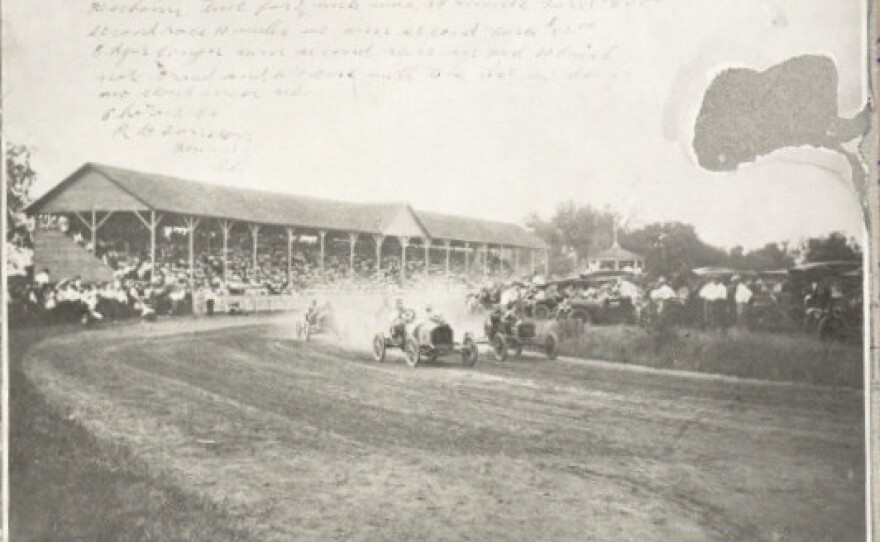
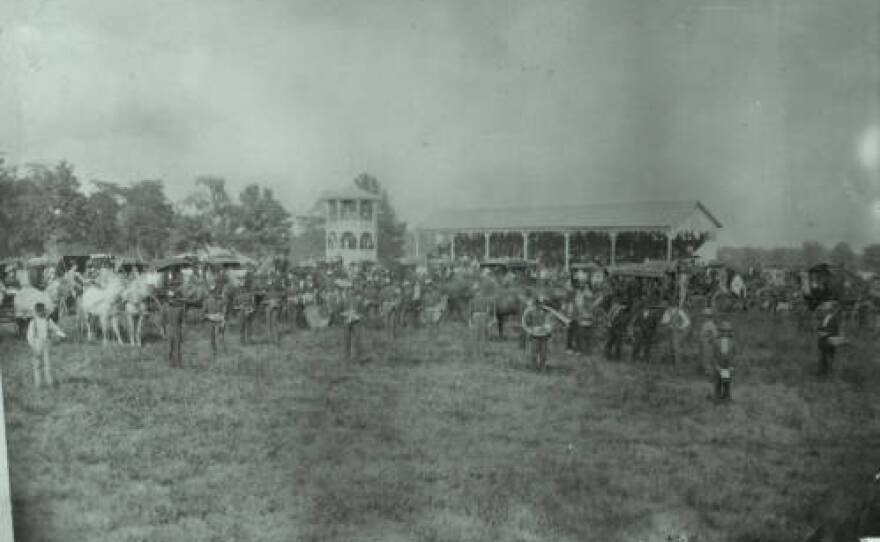
On September 11, 1921, more than 1,600 people crowded into the Macomb Fairgrounds for what newspapers would later call the “Game of the Year.” The fierce baseball rivalry between Macomb and Colchester had reached its final showdown, with the series tied two games apiece and local bragging rights on the line. Fans arrived early, wagers circulated through the crowd, and excitement ran high.
But before the first pitch was even thrown, controversy exploded. Colchester had recruited three former members of the infamous Chicago White Sox connected to the Black Sox scandal—Shoeless Joe Jackson, Eddie Cicotte, and Swede Risberg. They were among the eight players accused of throwing the 1919 World Series Game, and while acquitted in 1921, they were banned for life from playing Major League Baseball. Their appearance stunned spectators and immediately raised questions about fairness and gambling.
At the center of local rumors was Henry “Kelly” Wagle, a Colchester businessman, baseball enthusiast, and bootlegger. One story claims Wagle met Jackson at a pool hall near Chicago and helped arrange for the former major leaguers to come to Macomb. During Prohibition, bootlegging money and underground gambling networks flowed through communities large and small, making such arrangements possible.
Despite protests from Macomb fans, the game continued. Cicotte dominated on the mound, Jackson dazzled the crowd, and Colchester shut out Macomb 5–0, securing bragging rights for at least one year. Yet, long after the final out, people were left debating not just who won—but whether the game had truly been fair.
The episode was read and written by Sue Scott, Western Illinois Museum’s Executive Director.
Galesburg's First Labor Day Parade

The nation's first Labor Day celebration was September Fifth, 1882 in New York City. But Galesburg was not far behind.
On September Seventh, 1891, fifty-eight carpenters, forty tailors, and eleven cigar makers... lined up for Galesburg's -- and the nation's -- very first Labor Day Parade. They marched on Main Street to a city park for a festive picnic. Among the speakers, Congressman George W. Prince said union workers deserved an annual holiday. Three years earlier, in 1888, the mood on Main Street was quite different... There was a massive funeral for a union worker, killed during a strike by railroad unions. That same year, there were riots in Chicago, and union members were arrested for blowing up trains and tracks with dynamite. In 1894 Congress established Labor Day as the first Monday in September. And every year at the Labor Day parade on Main Street in Galesburg, union members march and toss candy to hordes of kids, who may not know the history of the day, but they know what they like.
This episode was written by Peter Bailley with help from Barbara Schock.
Nauvoo Winemaking Tradition

For many people, the name Nauvoo is synonymous with wine. Several of the early settlers of Nauoo brought grape vines with them and found the soil was very good for growing grapes. Father John Alleman of the Catholic church, John Tanner, and Alois Rheinberger were some of the first to start growing grapes and making wine in Nauvoo. Alois Rheinberger planted the first commercial vineyard and he was soon followed by many others. Hundreds of acres around Nauvoo were planted in grapes for the more than 70 wineries that were in Nauvoo. The Icarians brought grapes from France to Nauvoo and with them came the Baxter family. The Baxter family started their winery in
1857 and it is the oldest bonded winery in the state of Illinois. It is still owned and operated by the Baxter family today continuing the Nauvoo wine making tradition.
This episode was written by Rebecca Williamson.
Iowa Ordnance Plant

Imagine a town the size of Burlington having a sudden 50% growth spurt. In 1040, the federal government decided on a site a few miles west of Burlington as the future home for the Iowa Ordnance Plant.
the first task was to remove 183 farms. That fall, the surprise announcement Coincided with offers for each of the farms. While the offers were at a fair price, few if any of the farmers wanted to move. But, of course, they were not given a choice. Some still has crops int he field and few, if any, knew where to go.
Nevertheless, the government was moving quickly so the farmers had to do likewise. Almost immediately, thousands of construction workers descending on Burlington. Rental were snapped up immediately. As many as 38 people inhabited a single dwelling including the attic accessible only by fire escape. Other rented rooms by the shift in order to accommodate multiple people. A new development sprang up, as did trailer courts.
With bombs and artillery shells being made, the occasional explosion meant injuries, deaths and cracks in the walls for miles around. World War II was definitely a time of boom AND bust for Burlington and the surrounding area.
This episode was written by Mary Krohlow.
Birth and Evolution of Smithshire

In Warren County Illinois, the small community of Smithshire has a story that begins with both nature and opportunity. Long before Smithshire existed, nearby Ellison was the center of local life. It was founded in the 1830s and home to the first settlers in the area. But in 1858, a devastating tornado tore through Ellison, leaving destruction in its wake and halting the town’s growth.
Decades later, in 1888, a new force reshaped the region: the railroad. The Atchison, Topeka & Santa Fe Railway built a line through Warren County, and with it came a chance to start fresh. Residents and businesses from Ellison packed up and moved closer to the tracks, founding what we now know as Smithshire.
The town quickly became a hub for agriculture. Grain and livestock from surrounding farms traveled by rail to markets far beyond Warren County. Small businesses popped up, supporting farmers and travelers alike, while the town’s compact size kept life close-knit and community-centered.
Smithshire remains small. It never incorporated, but it is steady service point for the Ellison township and a reminder of how towns adapt to nature, commerce, and survival.
This episode was written by Ann Tenold
Kiltz Farms

Farming has been a vital part of Schuyler County since it was first inhabited. Agriculture drives the local economy and it always has. The present Klitz Farms traces its roots back to an 1838 land purchase by George Ritchey. Over generations, this farmland was passed down and expanded. In 1972, Carson Klitz, a lawyer with a passion for farming, purchased a piece of farmland that he calls “The Bottom Farm”. It is his favorite because the farm has “character”, and has been for the last fifty years.
His son, Christopher Klitz, officially established Klitz Farms in 1992 after graduating from college. Christopher had a deep connection to farming from a young age, inspired by his grandfather. Upon returning home, he expanded the farm through multiple land purchases, including properties in Littleton, Oakland, and Rushville Townships. Over the years, he and his father acquired more land, bringing the total to 2,400 tillable acres.
Today, Klitz Farms stands as a testament to nearly two centuries of family dedication. Through expansion and a passion for agriculture, Christopher continues to build on the legacy started in 1838, and hopes to pass it on to multiple generations, making Klitz Farms a key part of Schuyler County’s farming community in the present and in the future.
This episode was written by Jason Klitz
“Rebel Raid on Canton Missouri!”

“Rebel Raid on Canton Missouri!” declared the New York Times on Aug 6th 1862. Three days prior, some 200 mounted guerillas had been dispatched by Col. Joseph Porter, Northeast Missouri’s most famous guerilla leader, to recruit, forage, and boost morale of local partisans, who had sent word that the town was left unguarded. And with some 75 muskets rumored to be in merchant J.W. Carnegy’s warehouse near the river, Canton was an opportunity not to be missed.
Like other area communities during the Civil War, Canton was deeply divided politically but also united by common tragedy. Though formal engagements were few in the area and had largely ceased by 1862 as the war shifted Southward, the constant threat of partisan violence remained as seen in the story of the raid on Canton and the only wartime casualty in city limits.
At the time of the raid, J.W. Carnegy and several associates were packing their wares to ship North for safekeeping. But It was too late. They heard the approach of horses. Carnegy called out “Who comes there?” and was answered with a shotgun blast. A Lieutenant Garnett had fired a heavy charge of buckshot into Carnegy’s stomach, dealing a mortal wound.
Garnett dismounted, knelt and said “I am sorry for this, but, my friend, you ought not to have halted me.” After the shooting, the rebel column assumed control of the town. They remained until Saturday morning, liberating the rumored muskets and a considerable supply of ammunition. Some unionists were taken into custody or robbed but the guerillas, seemingly aware that part of the town supported them, refrained from looting stores and released prisoners after leaving. Carnegy lingered until the following Sunday and died in a nearby boarding house.
Canton newspaper editor Jesse Barret confirmed the restraint. “Whether the tragic occurrence served to sate the intended vengeance or to modify original intentions is all a matter of conjecture…But so far as we can learn, and to the utter disappointment of some of our citizens, they took no plunder.” Despite the almost complimentary tone, the editor nonetheless feared what the death signaled.
“Through all the difficulties of the past this immediate region has been happily exempt,” asserted Barret, “but if the muttered threats of vengeance are to be executed—God pity the people that have no mercy for each other.” J.W. Carnegy was buried in a private cemetery under an obelisk that still stands today, quietly testifying to tragic years when area communities turned on each other and themselves. As the Canton Press lamented the day of his funeral, “Alas! What desolation has been carried to countless firesides by the terrible visitations of civil war.”
This episode was written by Scott Giltner.
Keokuk Library

In 1851 and 1854, Keokuk residents attempted to form a library association, but funding fell short. In 1863, renewed efforts succeeded—funds were raised, bylaws adopted, and the Keokuk Library Association was established.
The library opened June 1, 1864 at 80 Main Street, with 185 members and over 2,500 items. Within a year, it expanded into adjacent space over a local bank was open from 2 to 10 PM.
In 1879, an endowment from the estate of Judge J. L. Rice enabled the library to secure its own building. The newly constructed library at 3rd and Main opened in 1883, with rental shops below and the library above.
An election in 1894 meant the city would take ownership of the association and its services, and the Keokuk Public Library was born. The library at 3rd and Main continued until a brighter and more accessible space was desired. This led to the construction of a new building: the library in the round.
The current library building opened in 1962 at 210 North 5th Street, with over 300 checkouts reported on opening day. It continues to grow and evolve, honoring a tradition which began more than 160 years ago.
This episode was written by Angela Gates of the Keokuk History Center
On the Oregon Trail

In the spring of 1850, a small but determined group of settlers left Monmouth, bound for the distant valleys of Oregon. While many Illinois emigrants on the Oregon Trail remain anonymous, Monmouth is one of the rare towns that can identify actual Oregon Trail settlers by name.
They traveled west to the Missouri River, joining other emigrants embarking on the Oregon Trail migration. Their wagons carried flour, tools, seeds, and hope. The journey stretched nearly 2,000 miles across plains, rivers, and mountains. Disease, exhaustion, and uncertainty followed them every step of the way.
These settlers were not simply seeking land, they were building something lasting. Many were members of the Disciples of Christ, and they envisioned a town centered on faith and education. When they reached the Willamette Valley, they founded a new community and named it Monmouth, after the town they had left behind.
This episode was written by Ann Tenold.
Burlington's Know it All

Burlington old-timers didn’t need Google. They had Myrtle French. She nearly always had the answer, and when she didn’t, she’d find out.
In the leadup to World War II, life was promising. She had a beloved aunt – and she was engaged to be married. Then both died - leaving Myrtle at loose ends – without a clue as to what to do with her life.
When it was reported that the Burlington area would become home to the Iowa Ordnance Plant, she knew. Huge numbers of people would be moving to town – and they would need lots of help as they settled in.
Myrtle opened French’s Information Service. In a six-month period during 1942, she found housing for 600 people. During the ensuing decades she handled a wide variety of queries. She found storage for construction equipment and when she could find no driver, she drove them herself. She located an elephant for Jimmy Dorsey. A snake babysitter was needed. The Beatles were looking for a violin string.
Myrtle was popular socially. That is until 1949 when she attended the hobo national convention in Britt, Iowa. She was voted Queen of the Hoboes and dubbed Box Car Myrtle – again and again over the next decade. Invitations dried up. When she discontinued her Hobo phase, popularity returned. Prior to her death in 1976, she penned her autobiography, “Myrtle Knows the Answers.” No Google necessary.
Avery Brothers - Galesburg Entrepreneurs

In the Civil War summer of 1864, Robert Avery had a lot of time on his hands. A sergeant in the Union Army, he had been captured by Confederate forces and was held in the notorious Andersonville prison. The inventive farm boy from Galesburg drew diagrams of machine parts in the sand, and carved them from wood scraps. He survived six months in Andersonville, as well as a solo battle with typhoid back in Illinois after the war.
Through the 1870s, Robert and his brother Cyrus, both graduates of Knox College, made good use of their complimentary skills. Robert perfected labor-saving farm devices, while Cyrus built the hugely successful Avery Planter Company. They built steam-powered farm equipment and later expanded into gasoline-powered vehicles.
Despite their innovations, the company closed in the 1940s. Their family history is equally notable.
Before the Civil War, their father, George Avery, emancipated an African-American slave whom he had inherited from a friend. Through their mother, Seraphina Phelps, they are related to
Riley Root -- another genius inventor from Galesburg's early history...but that's a story for another day.
This episode was written by Peter Bailley with help from Barbara Schock.
1941 Fire at Macomb Motors


On June 24th of 1941, the Macomb Daily Journal reported a dramatic fire at the Macomb Motor Company building at Lafayette and Washington Streets. Many in Macomb already knew the news because crowds of residents had gathered to watch the flames and help fight the blaze. One of the owners, James Trapp, discovered the fire after two boys ran from the garage to warn him. Phone lines were damaged, delaying the call to the fire department, and confusion over which Ford garage was burning slowed the response. Flames shot twenty feet from the windows as paint and oil cans exploded, and fire departments from Bushnell and Colchester were called to assist. The fire raged for more than an hour, causing an estimated $36,000 in damage, but remarkably, only one worker was slightly injured.
By the end of the year, the building was rebuilt and doubled in size, and today it still stands at 201 South Lafayette Street. Now home to the Western Illinois Museum, it preserves both its own story and the history of the community, serving as a lasting reminder of Macomb’s resilience and determination.
This episode was written by Sue Scott.
The Princess Theater

The present Princess Theater on East Lafayette Street in Rushville, IL, held its grand opening on May 12, 1917, under the ownership of Carl Pearson. The featured film was Fires of Conscience starring William Farnum. The matinee began at 2:30 pm and cost ten cents. Back then the theater had an orchestra pit because movies were silent and were accompanied with a soundtrack played live. The original theater had no concession and although popcorn was sold at a nearby corner stand, oddly enough it was illegal to bring into the theater.
By 1929, “talkies” or movies with sound, became the norm and Pearson installed a new sound system. He also added air conditioning, which made the Theater a popular spot on hot summer days.
In 1938, Carl Pearson’s son, Lloyd, took over and changed the name to Lloyd’s Theater. Lloyd sold it to Ray and Margie Roloff in 1976, who renamed it Schuy-Ville Theater. Dave and Pat Grate were the last owners of the Schuy-Ville when it closed in 1993.
In 1995, the Princess Theater Corporation closed a deal with Grates and bought the property. Renovations followed and on September 8, 1995, the Princess Theater reopened with the movie Apollo 13 starring Tom Hanks. The theater continues to show “family friendly” movies to this day and has become a part of the nostalgia of growing up in Rushville.
And by the way, popcorn is now sold in the Princess Theater.
This episode was written by Brian Schmidt.
Keokuk's First Automobile

Keokuk’s first automobile was reportedly purchased by Dr. C. E. Ruth, a surgeon at St. Joseph’s hospital. It could carry two passengers, though it often failed to carry any.
Soon after, electrician Frank Knight rolled out a homemade car. Though odd in appearance, it was practical—except on steep hills. His three-wheeled, box-like vehicle resembled a large tricycle, with front-wheel steering and a carriage-style seat above the rear wheels.
Knight, a brilliant scientist and mechanic, used the car for many years. After his death in 1938, his estate funded a redesign of the children’s room at the Keokuk Public Library. His bright yellow, single-cylinder, water-cooled car was displayed there until 1972, when it was driven in Keokuk’s 125th jubilee. It then returned to the library and remained on display until 2005, when it was loaned to the Spaulding Center for Transportation.
Today, Frank Knight’s unique automobile is housed at the Antique Car Museum of Iowa in Coralville.
This episode was written
Indigenous Peoples in Monmouth

In what is now Warren County, Illinois, land was historically inhabited by several indigenous peoples, primarily from the Algonquian-speaking and Siouan-speaking groups. Kickapoo, Potawatomi, Meskwaki, Sauk and the Illiniwek Confederation, used the land as hunting grounds rather than a permanently settled area. European settlement and displacement in the 18th and early 19th centuries pushed most of these groups west of the Mississippi.
These first nations lived in harmony with the land, hunting, fishing, and tending crops along the rivers and prairies. Their presence shaped the rivers, forests, and valleys, and their stories, traditions, and stewardship of the land continue to resonate, even after centuries of displacement.
As we walk these landscapes today, we honor the communities who called them home long before there was America. Their resilience, knowledge, and culture are part of the living history of Illinois.
Take a moment to remember, this land has a story far older than our own
The episode was written by Ann Tenold.
Here’s to You, Mrs. Roosevelt


In October 1953 Culver-Stockton College celebrated its centennial by welcoming one of the institution’s most prestigious guests, former First Lady Eleanor Roosevelt.
Mrs. Roosevelt flew into Quincy’s Baldwin Field from St. Louis and was driven to Canton by President J. Leslie Ziegler at the head of a 100-car parade. “Their college was established 100 years ago and they are celebrating this fact,” remembered Mrs. Roosevelt in her diary. “They are also very proud of the fact that they were the first coeducational college established in this whole area.”
While in Canton, she lunched with the female student body, was guest of honor at a coffee reception where she received well-wishers, and signed copies of her book India and the Awakening East. The main event was her late afternoon address “The World Today in Relation to the United States,” where she promoted American leadership in the new United Nations. “Mrs. Roosevelt has always supported any movement towards the betterment of Civilization,” noted the LaBelle Star, and her remarks that day reflect that. Delivered in front of more than 1,100 people packed into tiny L.L. Culver gymnasium, her remarks challenged the world, and Culver-Stockton students, to become much better at talking to one another in the aftermath of another world war.
For dinner, Mrs. Roosevelt recalled, “my kind hosts took me to dinner in a place where you saw ham being barbecued, turning round and round on a spit, and of course we had barbecued ham with a delightful sauce.” Then President Ziegler drove Roosevelt to Kirksville for the next day’s events at Northeast Missouri State College (now Truman State).
But the visit would not be her last contact with the college. Three years later when Culver-Stockton sent a delegation to the Disciples of Christ’s annual U.N. Seminar, they wrote to Roosevelt. Thus on December 4th 1956, five students and one faculty member dined with Eleanor and actress Irene Dunn and talked international diplomacy. “Peace doesn’t fall on you from heaven,” Mrs. Roosevelt had warned that day on the Hill in 1953. “It is a long process of growing understanding between nations and peoples…it is the ability to have stamina enough to keep going on, not to give up because of disillusions and disappointments.”
Humorists along the Mississippi

Robert Burdette, the Hawk Eye city editor in the 1870s, began by writing a humor column in the staid old newspaper. It achieved such astounding success that he also went on the road as a lecturer and humorist. While his name is less recognizable today, he was right up there nationally with the likes of Mark Twain and Artemus Ward. In the end, he forsook this career for theology and established a mega church in Los Angeles.
Mark Twain frequented the Mississippi River and even worked for newspapers in Keokuk and Muscatine. He is primarily remembered as an author with books such as Tom Sawyer. Going on the road usually meant that he had overspent and needed to replenish the coffers. When Huckleberry Finn was published, he toured with George Cable and appeared at Burlington. The reviews were good. But three days earlier, the Quincy Daily Journal disagreed: “Little, plain, simple, unpretending Bob Burdette gave an entertainment at our opera house one night all by himself that discounted the Twain-Cable entertainment one thousand per cent. Bob's lecture was rich in wit and humor, and rich in pathos.”
This episode was written by Mary Krohlow.
Nauvoo Temple Fire

At 3 am on October 9, 1848, residents of Nauvoo were awakened by the alarm of a fire at the Temple. By the time the blaze was noticed, the fire was through the cupola and the structure was quickly fully engulfed. The flames could be seen for miles around and the crackling of the timbers could be heard in Montrose. The temple had been left by The Church of Jesus Christ of Latter-day Saints when they left Nauvoo for Utah in 1846. Finally, only the walls were standing and it was quickly determined that arson was involved. No one was ever convicted of the arson, but in 1870 a supposed deathbed confession was printed in the newspaper naming 3 individuals responsible, however it was never confirmed. In 1850 the remaining walls of the temple were destroyed by a tornado and the temple stones were reused in various buildings throughout Nauvoo. In 2002 the temple was rebuilt using the same plan and design of the original structure.
This episode was written by Rebecca Williamson.
Ellen Browning Scripps

Ellen Browning Scripps was born October 18, 1836, in London, England to James Mogg and Ellen Mary Scripps. After the mother died, in 1844, the family left England, and joined family in Rushville,IL, where they settled on a piece of land that is today Scripps Park.
Ellen went to school in Rushville then to Knox College, in Galesburg. She taught for 8 years in public and private schools.
In 1873, Miss Scripps invested her money in her brother James’s new paper, the Detroit Evening News. In addition, she worked for the paper and always reinvested her wages back into the paper. Then in 1878 she joined her brothers, George and Edward, in creating the Cleveland Press. She continued to work for her brothers’ expanding newspaper business, and of course investing her money in them.
She became a very wealthy woman, retired to California, and invested in philanthropy. She helped to found the Woman’s Club, the Public Library, the Scripps Memorial Hospital, the Bishop’s School, the Community House and Playgrounds, Children’s Pool, Scripps Institute of Oceanography, just to name a few.
Finally, she donated money for Scripps Park in Rushville, and funded the building of the Virginia community building in honor of her sister, Virginia. The building and park remain today. Ellen Browning Scripps passed away in 1932, and is buried in Rushville.
This episode was written by Ana Eveland.
Galesburg's First Car and First Car Race

Two guys get new cars -- what's the first thing they do? Have a race to who's faster. This is the story of Galesburg's first car, and first car race.
In the summer of 1899, a local newspaper reported... “Galesburg will soon be introduced to the motor carriage. The automobile recently ordered by Dr. Ewing Morris is now delivered at the Santa Fe railroad depot."
The Winton Phaeton had a one-cylinder engine,
top speed of 40 miles an hour. The tank held enough for seventy-five miles of level road. Morris paid $1,000 -- equal to about $40,000 today. Not bad, for a ride with padded seats, leather roof, and gas head-lamps.
A few months later, Morris was challenged by Mr. F. B. Snow, who had a brand new Duryea roadster. The 100-mile race was held at a local horse track. The racers averaged about 30 miles an hour.
After only 15 miles, Snow's engine failed, and Morris was declared the winner. Two years later, Morris traded his gas auto for Galesburg's first electric car. There's no word on whether he raced again.
This episode was written by Peter Bailley with help from Barbara Schock
Warren County's Prime Beef Festival

It’s 1948, a newly energized City of Momouth Chamber of Commerce hired a young man named Bob Albert. Bob’s mission: put Monmouth and all of Warren County “on the map.”
That year, Warren County shipped more beef to Chicago’s Union Stockyards than any other county in the region. That achievement earned the proud title: “Prime Beef Center of the World.”
So Bob Albert, inspired by both community and cattle officially declared that year’s fall festival the first annual Prime Beef Festival. It was held over 3 days on Monmouth’s Public Square.
From that beginning, the Festival has grown and evolved but never forgotten its roots. In 1953, the event moved from the busy Public Square to the calmer setting of Monmouth Park to accommodate traffic and growing crowds.
The Prime Beef Festival became known for its massive community volunteer force, with hundreds of locals helping cook, serve, and organize events throughout the week. In the 1960s and ’70s, the parade grew into one of the area’s largest, drawing marching bands and floats from across western Illinois. By the 1980s, the Festival had added motorsports events like the figure-eight races and the demolition derby, cementing its reputation as both an agricultural celebration and a county-wide party.
Every year, the heart of the Festival remains the same: a celebration of where we came from and where we’re going. In 2024, the Festival celebrated its 75th anniversary, themed “Prime Beef Through the Ages,” bringing back some old traditions like a baking competition and dunk tank. It honored its history while welcoming new memories. Carnival rides, livestock shows, a big parade downtown, figure-eight races, a demolition derby, a Princess Pageant, kid-friendly events, vendor tents, food, music... basically something for everyone. The Warren County Prime Beef Festival is a legacy. The legacy of beef, community, volunteering and heart. It’s a part of our heritage in Warren County.
Keokuk's Professional Baseball History

Keokuk boasts a rich history for sports fans. It provided Iowa with its only major league team and was one of just two cities west of the Mississippi in the majors for over 75 years.
In 1875, Keokuk’s Westerns were one of thirteen teams in the National Association of Professional Baseball. Playing at Perry’s Park, the team arranged cheaper transport to boost attendance, but the season opener—and many games after—were disappointing.
By 1885, the Keokuk Hawkeyes tried again, featuring future Hall of Famer Bud Fowler, the first Black professional baseball player.
After 1900, several teams followed: the Indians, Pirates, Kernels, Cardinals, and Dodgers. The Indians, affiliated with the St. Louis Cardinals, won the 1931 Mississippi Valley League Championship with a 73-51 season.
The Pirates played under the Pittsburgh Pirates organization but folded in 1949 when the Central Association ended.
In 1952, the Kernels—named after the Hubinger Company and affiliated with the Cleveland Indians—debuted. Roger Maris joined the team, and in 1955, the Kernels won the Iowa-Illinois-Indiana League Championship with a 92-34 record.
By 1963, professional baseball left Keokuk. Through a history spanning nearly 90 years, many future stars passed through, and generations of fans enjoyed the national pastime.
This episode was written and voiced by Angela Gates of the Keokuk History Center.
The Cholera Epidemic of 1834

In the northwest corner of the Rushville City Cemetery is a large open area with no headstones. This spot marks the mass grave of at least twenty seven victims of the 1834 cholera epidemic.
The cholera arrived in Rushville on July 3, 1834, when two citizens, William McCreery and C.V. Putnam was summoned to assist with the body of a Mrs. Wilson, who had died on a boat on the Illinois River. McCreery and Putnam were the first two victims of the cholera in Rushville. McCreery’s parents perished four days later. Twenty-two deaths occurred in the first eleven days of the disease.
Panic ensued as people fled the city for relatives in the country or simply moved out into the woods. Rushville was nearly abandoned. Staying behind to help nurse the sick were the Rev. John Scripps and his wife Agnes, E. H. O. Seeley, Dr. VanZandt, Daniel Sherwood, John York, William Willis, and a Mr. Wilson. They set up a hospital in a two story frame building and set to work nursing the sick. Sherwood, York, and Willis soon fell victim to the disease.
Scripps soon came down with the disease himself. However, the Reverend survived, and the last victim perished on August 1. The disease had run its course.
No one will ever be sure how many actually succumbed to the disease. Today, a memorial marks the spot and contains twenty seven names of known victims. The cholera returned again in 1841 but was less severe than the Cholera Epidemic of 1834.
This episode was written by Brian Schmidt.
Nauvoo Blue Cheese

In 1937 the method for making blue cheese from cow's milk was perfected at lowa State University. Oscar Rohde had taken part in the program and afterwards he moved with his wife Mildred to Nauvoo to begin the manufacture of blue cheese. He knew that Nauvoo had several caves in the area and he purchased the old Schenk brewery because it included a series of caves. The caves kept the cheese at the ideal temperature for the cheese to form and soon Rohde had a very successful business. It took approximately 50 lbs of milk and 90 to 120 days of aging in the caves to produce six pounds of blue cheese. In 1983 Nauvoo Blue Cheese was selected as the best blue cheese in the United States at the prestigious United States Cheese contest. The business was sold in 1987 to Raskas then to Con Agra and then Suputo and was ultimately closed in 2003. The property was purchased by the Church of Jesus Christ of Latter-day Saints and the buildings were demolished. The area is now a parking lot, but a lone stone structure remains to mark what was once the largest business in Nauvoo.
This episode was written by Rebecca Williamson.
Governor Thomas Ford Arrested in Rushville

In 1844, in Hancock County, IL, trouble was brewing between the citizens and the Mormon settlement at Nauvoo. Governor Thomas Ford was forced to call up the Militia. This included the Springfield Cadets commanded by Governor Ford himself. On their journey the governor and his Cadets made it to Rushville toward the evening and decided to make camp on the village square.
On that evening the governor was feeling restless and unable to sleep so he decided to have a little pistol practice not knowing that it was illegal to shoot guns in the city of Rushville. James Little of Rushville apparently had no trouble getting to sleep that night. That is until the firing began. After being awakened, Little found local Justice of the Peace Jacob Jones and had the governor arrested.
After paying the fine, the governor moved his Cadets on to Carthage. After finishing their business there, they made their way back toward Springfield and again made it into the Rushville Square at nighttime. Nobody knows how James Little was sleeping that night, but the Cadets led by Ford moved in quietly. Upon reaching the square they loaded a howitzer cannon with “heavy blank cartridges,” and then fired it into the air. The concussion of the blast broke windows in the nearby court house.
Immediately afterward, the governor and the Cadets marched out of Rushville. So although Governor Ford was the first governor of Illinois to be arrested (not the last), he did get his revenge on the quiet “Little” town of Rushville.
This episode was written by Brian Schmidt.
Hartzell Spence, One Foot in Heaven

It struck Burlington bigtime. Hartzell Spence, now in his 30s, had just published a book – “One Foot in Heaven.” Hartzell’s father had served as pastor of Burlington’s First Methodist Church. Young Spence could be a hell-raiser but he was smart, handled three newspaper delivery routes and was editor of the school newspaper. He also worked for the Hawk-Eye during his senior year. Years later, during World War II, he served as the first editor of “Yank” newspaper for the soldiers – and included pinups, a word he coined as a noun.
While climbing the ladder at United Press before the war, he was writing and finally achieved success with the 1940 publication of “One Foot in Heaven.”
Was it fiction or was it biography? It was about a Methodist minister and his family in a Midwestern town called Riverton. He did say some nice things about the town. But then he struck at its people: “The city was notable chiefly for its insincerity and entrenched smugness.” In addition, he launched a venomous attack on some of the church leaders.
The book was a must-read for Burlingtonians. The library had to order more and more copies. Identifying the characters in real-life became a favorite pastime.
Then salt was rubbed in the wound when “One Foot in Heaven” opened as a movie the following year – starring Fredric March and Martha Scott. And, of course, it was nominated for the Academy Award for Best Picture.
This episode was written by Mary Krohlow
Temperance and its Evil Twin

Galesburg was founded in 1837 by evangelical Christians from New England. First and foremost, they were anti-slavery. But they also wanted to abolish liquor. One of their first official acts was formation of a temperance society. After the city received its charter in 1857, citizens voted to prohibit alcohol.
Religious revivals promoting temperance washed over the countryside... with varying degrees of success. Preaching and prohibition failed to eliminate liquor. What people wanted, bootleggers delivered.
In 1872, Galesburg aimed to limit the illegal trade by licensing the sale of liquor by the drink. The anti-liquor faction swung into action. Within two years, Galesburg had a chapter of the Woman’s Christian Temperance Union, and public outcry resulted in revoking the liquor licenses. Galesburg women -- including educator, journalist and missionary Mary Allen West -- were among the leaders of the national temperance movement.
This episode was written by Peter Bailey with help from Barbara Schock
George Hendry

Not long ago, I learned that Canton Missouri’s Culver-Stockton College first won a team national championship in an unlikely sport—Table Tennis. C-SC won the 1941 national championship, even hosting the event on campus. The team had come in second the previous year and their strong showing was one of the reasons the school was chosen to host the next year. How did little old Culver-Stockton College come to be a ping pong powerhouse, finishing second in the nation in 1940 and first in 1941?
It’s a fascinating story that connects Culver-Stockton, a Wheaties box, and Cardinals Hall of Famer Stan Musial. This is the story of former C-SC student and all-time table tennis great George Hendry.
George Hendry was born in 1921 and raised in St. Louis. At age 12 he picked up the sport of table tennis that would make him famous. He won his first national junior table tennis championship in 1935 and was honored for that achievement when Wheaties issued a box with his face on the cover. He was apparently paid $25 and two years worth of Wheaties.
In September 1940, George enrolled at Culver-Stockton with his brother Don, with whom he had won (and would win future) national doubles championships. During his time on the Hill, George and Don played exhibition matches at halftime of basketball games to entertain the Wildcat faithful, made the squad nationally competitive, and in December 1940, winning the individual national intercollegiate Table Tennis Championship at Princeton University and helping the team secure a national second place finish.
George’s championship and the team’s second place finish led to C-SC being tapped to host the 1941 Tennis Championship. George and Don both delivered before the home crowd, with George repeating and earning tournament MVP, and he and Don helping the Wildcats defeat second place Washington University and third-place Illinois for the title.
In 1942, George was drafted, served as an Army medic in the Philippines and earned two bronze stars. He didn’t return to C-SC after the war, but would eventually complete his degree in accounting at Washington University. By the end of the 1950s, he would retreat from table tennis competition. Incredibly, George would return to competition in 1976 at age 55 and continued playing competitively until he was 89 years old. When asked how he managed to remain an elite player at his age, Hendry noted “I ate my Wheaties.”
All told, Mr. Hendry won 70 men’s singles tournaments and an astonishing 35 national singles and doubles championships. He put Culver-Stockton on the map for a brief few years as the national epicenter of collegiate table tennis and delivered individual and team championships. He was inducted into the national Table Tennis Hall of Fame in 1980 and continued to win championships for nearly 30 more years.
American hero and former C-SC Wildcat George Hendry died in 2011 at age 90. The St. Louis Post-Dispatch ran his obituary with the headline “George Hendry Dies, the Stan Musial of Table Tennis.” But given his dominance over such a long and storied career, I would suggest that we might refer to Stan the Man as “The George Hendry of Baseball.”
This episode was written by Scott Giltner.
Fort Madison Penitentiary

The Iowa State Penitentiary in Fort Madison stands as the oldest prison west of the Mississippi. Built in 1839—seven years before Iowa even became a state—it operated for 176 years, making it one of the longest-running prisons in the country.
Constructed with locally quarried limestone, the prison housed thousands of inmates over the decades. While it wasn’t known for infamous criminals, it was the setting for plenty of fascinating stories—escapes, reforms, and the ever-evolving approach to incarceration. The penitentiary became a major employer for Fort Madison and a defining part of the city’s identity.
In 2015, the prison officially closed, replaced by a modern facility nearby. While no tours are available, the massive stone structure remains an imposing landmark, easily visible from the outside. Its walls hold nearly two centuries of Iowa history, a testament to Fort Madison’s resilience and role in shaping the state’s past.
Naming of Warren County

In the early 1800s, Illinois was still a patchwork of prairies and frontier settlements, but Illinois lawmakers were choosing names meant to inspire the generations who would follow. One name stood out: Warren. Early Americans honored Revolutionary War heroes when naming new counties, towns, and landmarks during westward expansion.
And so, Warren County, Illinois, was named in honor of Dr. Joseph Warren, a man whose story is woven into the earliest fabric of the American Revolution. Warren wasn’t a typical founding hero. He wasn’t a president or a general who lived to see independence. Instead, he was a physician turned patriot, a leader whose resolve helped spark the earliest momentum toward independence.
On June 17, 1775, at the Battle of Bunker Hill, Warren volunteered to fight as a common soldier, despite holding the high rank of major general. It was there, in the smoke and chaos of one of the Revolution’s earliest and fiercest clashes, that he was killed. His death sent shockwaves through the colonies and turned him into a symbol of sacrifice for the cause of liberty.
On the frontier, stories of the Revolution were everywhere: in schoolbooks, in Fourth of July speeches, in the patriotic culture that helped define the young nation. Even in newly settled Illinois, people knew Joseph Warren as one of the first great martyrs for American freedom. The men in the Illinois legislature who established Warren County were part of the first generation after the Revolution. So, when the name “Warren County,” was chosen, a new community was anchored to the ideals Joseph Warren died defending: courage, conviction, and the belief that ordinary people can shape the destiny of a nation.
The episode was written by Ann Tenold.
Sailing to Montrose

On March 11, 1963 Red Front Tavern regulars got involved in a discussion about the Mississippi River. The winter of '63 had been hard and in March the river was still high with huge pieces of ice. Someone remarked that conditions were very bad, and someone else then disagreed and said that if necessary you could still cross the Mississippi to Montrose in a small boat. In no time at all the lines were drawn into two factions, some said yes, and some said no. The wagering then started and the stakes became higher and higher. Finally a group of five brave, or crazy souls made the crossing in a small wooden boat with an ample supply of liquid courage. They planted a flag on the lowa shore, purchased more beer, and sailed back across the river. The crossing by Fred Barbley, Bud Kachle, Gerald Knipe, Jerry Knipe, and Bill Schmitz was immortalized in a painting by Don Beasley and can be seen today at the Weld House museum in Nauvoo.
This episode was written by Rebecca Williamson.
Rushville Hardware Store


117 West Washington Street in Rushville, IL, has had a hardware store on its site since 1852.
Originally, it was called Griffith Hardware and the business operated out of a small frame shack. In 1883, the small frame shack was replaced with a two story brick building fronting the public square. Two years later a brick warehouse was added to the rear and extended to Congress St. to the west. This allowed the company to expand and sell farm equipment.
In 1920, the business was purchased by Joseph Kerr and A. H. Parrott. It was called Parrott and Kerr. In 1924, disaster struck when a fire broke out on the upper floor of Parrot and Kerr. Fire soon consumed the building. As firefighters arrived from Rushville and nearby towns, citizens helped remove goods from buildings ahead of the flames. Tragedy struck when the wall at Nelson’s Clothing collapsed and killed four young people. The 1924 fire was the deadliest fire to ever occur on the public square in Rushville.
In 1925 the present store was completed. In 1929, A. H. Parrott passed away and Joseph Kerr became sole owner. The store has been in the Kerr family ever since. In 2025, Tom, a fourth-generation Kerr, and his daughter Angy (Kerr) Hardy, a fifth-generation Kerr, are the present owners.
This episode was written by John Haywood, Rushville Industry High School Student.
Rose Jolly

Rose Jolly lived a life devoted to community care, education, and civic service in McDonough County. As a young woman in the late 1800s, she was known for her independence, joining bicycle races in Galesburg, hosting social events for her friends at the hotel owned by her family, and traveling to Europe. She even worked briefly in Chicago as an undertaker’s assistant.
A turning point in the life of Rose Jolly came after she witnessed cruelty toward a cow by its owner, an experience that strengthened her commitment to protecting vulnerable animals, children, and families.
Jolly served as secretary and later president of the McDonough County Humane Society, working with Josie Westfall at the local orphanage to help place children in safe homes. At the time, humane societies often handled legal documentation, supervised removals, and managed the care of children as part of community welfare practice.
Rose Jolly was recognized for promoting cross-agency cooperation in child welfare by the Illinois State Humane Society. In addition to her work advocating for the children in the community, she cared for family members while managing the Jolly Hotel, balancing business responsibilities with community service. Remembered as determined and compassionate, her work helped shape early twentieth-century social welfare efforts in Macomb.
Photo: Rose Jolly Front Left
This episode was written by Sue Scott, Executive Director of the Western Illinois Museum in Macomb, Illinois.
Maquon's Mound Mineral Spring Water

People of all times have found reasons for making pilgrimages to the Spoon River area for relaxation and entertainment. Those in the late 1800’s and early 1900’s found a unique attraction at the spa on the Andrew Burnett farm one and one-half miles north-east of Maquon along the west bank of the Spoon. By this time there was a widespread interest in mineral springs throughout the country. In 1884, Burnett, quite by accident, discovered a spring in a field on his 260-acre farm. After the discovery of the spring, the water was piped into the Burnett home, a spacious 15 room white house on a hill overlooking the river area.
It didn’t take long to realize that the spring water had unusual properties. There is a letter on record from a chemist at the University of Illinois to Dr. E.E. Truitt, December 1898 reporting an analysis of a sample of the water. By 1898, Andrew and Elizabeth Burnett with the help of their sons Fred and Sam were bottling and selling the mineral water for medicinal and health purposes. It was known as Mound Mineral Spring Water from Maquon. In 1901 the product was renamed Aquae Vita, the water of life. In 1906 the company went public as the Aqua Vita Mineral Springs, with a capital stock of $30,000.00. Shares at 10.00 each quickly sold out. The water was entered in a competition at the St. Louis Exposition in 1904, it was awarded a silver medal for second place and was recommended as one of the best waters in the world.
About that time Andrew began to lose his eyesight and depended more on his children for help. His daughter Margaret and her husband George Ritchie moved to his home and became part of the business. They decided to develop a sanitarium and resort and on June 19, 1911, Maquon was treated to a formal opening. The old house was remodeled into 23 rooms, refurnished and made ready for overnight guests. Several cottages were added and rates at the resort were $8.00 per week for room and board.
It is not clear just how long the fascination for the mineral water and pleasures of the spa continued, but by 1915 the business was not paying, and Andrew had sold part of the farm to keep the springs going. At this time he decided to discontinue the Aquae Vita Mineral Springs Sanitarium and Resort and moved to Abingdon, Illinois where he died in 1924 at the age of 85.
Even after the resort was closed, the aura of glamour remained. Young and old alike often have reexamined the old trails and speculated on the mysteries of the old white house on the hill and the power of Maquon’s miracle water.
This episode was written by Kenny Knox.
Joe Jefferson

Early settlers sought entertainment. Taverns could fulfill some of the need. Later there would be real, live theatre at the Marion and Grimes Halls. Opening of the Grand Opera House in 1882 meant a few operas - but also concerts such as John Philip Souza - and theatrical productions ranging from comedies and minstrel shows to Shakespeare.
The Joseph Jefferson Troupe was the first to appear in Burlington - for several weeks in 1838. Little Joe was the youngest performer in the multi-generational Jefferson Company. And people loved him. Little Joe went on to achieve fame as an actor. In 1865, he and Laura Keane were the leads in “Our American Cousin.” Fate led him to leave the company. And President Lincoln was assassinated at a performance not long after.
Joe Jefferson became known primarily for his portrayal of Rip Van Winkle. During the next four decades, it became his acting life. And, yes, he did appear at the Grand Opera House - as did his sons, yet another generation of Jefferson actors.
(Note that this last paragraph isn’t necessary but if you have enough time for it, I think it’s funny.) In 1898, already in his 70s – Joseph Jefferson replied as follows to a Cincinnati bore who asked him when an actor ought to retire: “Well, counting the time for getting out of costume and the slowness of hackmen, I think an actor should retire at about 11:45.”
This episode was written by Mary Krohlow.
Jack Finney
Ghostly streetcars, invasions from space, time travel without time machines: Jack Finney imagined them all. As well as Galesburg - in the springtime.
Born Walter Braden Finney in 1911 in Milwaukee, Jack came to Knox College and lived in Galesburg with his aunt and uncle until he graduated in 1934. Finney left Galesburg but his fiction kept drawing him back.
Take the title story of his 1963 collection, "I Love Galesburg in the Springtime" - a tale of a small town haunted by a nostalgia so strong it summons real ghosts. It's one of a handful of modern fantasies Finney set in Galesburg or Midwestern towns that seem an awful lot like Galesburg. A place and a time can make great impressions on a person. Finney impressed others with Galesburg too. His description of the cherry trees once blooming on Galesburg streets brought readers from Japan to see them - sadly, years after the trees were cut down.
Finney is best remembered now for two of his most famous novels, "Time and Again," which Stephen King calls "the great time travel story" and the many times adapted for screen "Invasion of the Body Snatchers." He passed in 1995 at his home in California. But Finney's Galesburg is still alive and with us today.
This edition was written by Joel Ward and voiced by Joel Ward.
SOURCES
Jack Finney
https://en.wikipedia.org/wiki/Jack_Finney
Jack Finney loved the 'Burg Harry Bulkeley
https://www.galesburg.com/story/opinion/columns/2015/05/23/jack-finney-loved-burg/34493341007/
Knox College Archives Research on Finney by Joel Ward
IMAGES
Jack Finney https://www.fictionunbound.com/blog/2016/4/14/dont-you-forget-about-jack-finney

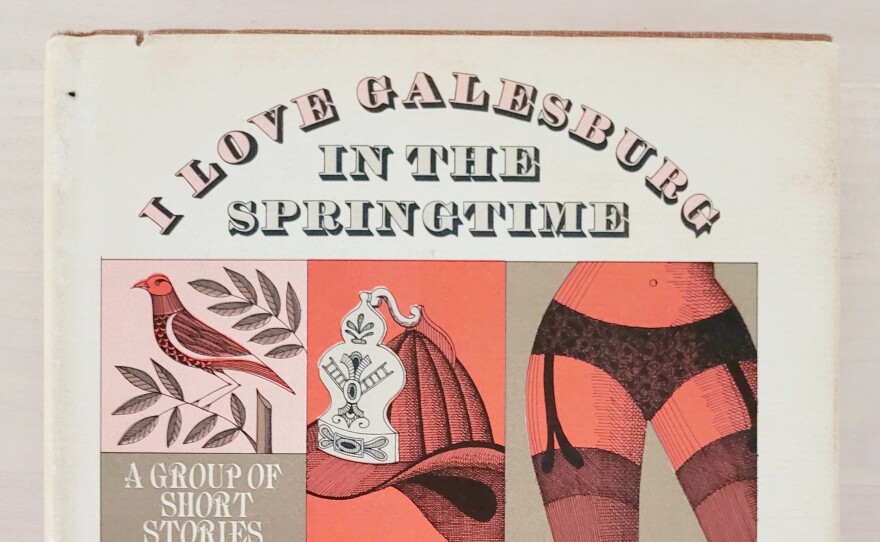


Book Covers From the personal collection of Joel Ward
1996-97 Rushville Basketball Team

The 1996-97 Rushville Rockets Boys Basketball team is remembered as a squad that defied the odds and achieved greatness. Coming off a dismal 2-28 season in 95-96, the Rockets were determined to turn things around.
Early on, the team struggled. But as the weeks passed, the Rockets began to show resilience, securing crucial wins and starting to gel under the leadership of Coach Jimmy Shepherd. One key contributor, forward Beau Fretueg, father of the author and present Superintendent of Schuyler-Industry Schools, recalled how the lessons learned from a rough prior season and the implementation of man-to-man defense helped the team grow stronger.
In the regional tournament, the Rockets hit their stride, defeating Beardstown and Brown County in commanding fashion. But the true drama unfolded in the Regional Championship, where they faced Augusta-Southeastern in a game that went into triple overtime. In an unforgettable moment, Bobby Ren hit the game-winning shot as time expired, giving the Rockets their first Regional title in 25 years.
This episode was written by Bennett Fretueg, student at Rushville Industry High School
Larger than Chicago?

Many people have heard it said that at one time Nauvoo was larger than Chicago. Was Nauvoo really larger than Chicago? Yes! In the 1840 census, Chicago's population was 4,470 people and Nauvoo had 2,700 people. In 1844, Nauvoo had grown to around 12,000 people, while Chicago was only 8,000. Nauvoo was the largest city in Illinois! Joseph Smith and The Church of Jesus Christ of Latter-day Saints were actively encouraging and helping people to immigrate from places like the United Kingdom to Nauvoo. So many people were arriving in Nauvoo that it was hard to keep up with building homes for them. People were living in tents and sod homes along with the wooden frame and brick buildings that we think of today. After the expulsion of the Saints in 1846 many of the buildings fell into disrepair and the population of Nauvoo dropped dramatically. The census in 1850 reported Nauvoo as having a population of 1,141 people.
This episode was written by Rebecca Williamson.
Keokuk Statue Story

In 1883, Chief Keokuk’s remains were removed from Kansas and he was reinterred at Rand Park overlooking the bluff. An inscribed, brownstone monument to the Chief was placed at the site to honor the city's namesake. It was thought that a likeness of Chief Keokuk should be placed at the top but years passed without much progress.
Back then, cigar shops were a must among local businesses. Keokuk was dotted with tobacconists who hand-rolled cigars by the thousands.
One cigar store in particular stands out among Keokuk’s history, that of Edward J. Bevering at the corner of 12th and High Streets. His cigar store had an Indian statue at the entrance, that is at least until Halloween of 1912.
That night, local pranksters commandeered the statue and relocated it to the top of the brownstone monument at Rand Park. The action itself may have been shenanigans of local teenagers, but it prompted the wheels to begin turning to place Keokuk’s likeness at the park. Funds were raised through efforts of citizens and the Daughters of the American Revolution and sculptor Nellie Walker of Chicago went to work creating a masterpiece.
On October 22, 1913, the ten foot tall bronze figure we see atop the monument today was unveiled. It had taken thirty years and the work of pranksters, but the completed statue was finally in place above the city named for Chief Keokuk.
This episode was written by Angela Gates of the Keokuk History Center.
Bart Howard

Howard Gustafson took to the piano at an early age. With his father having a side gig as a bootlegger, Howard had Burlington’s renowned pianist Martin Bruhl as his teacher - at a cost of one bottle of hooch for two lessons per week. By the time he was sixteen, he had his first major recital and moved on to a career in music.
The early years were unusual, as he played with a dance band touring with Siamese twins Violet and Daisy Hilton. And in 1934 he moved to Los Angeles to accompany female impersonator Rae Bourbon.
By 1937 he had changed his name to Bart Howard and moved to New York. Here he met Mabel Mercer, the first to sing one of the songs he wrote. In the 1950s he was emcee and intermission pianist at Manhattan’s stylish nightclub, the Blue Angel.
Songwriting finally paid off when he wrote “In Other Words.” Peggy Lee suggested he change the name to “Fly Me to the Moon” and the rest is history. In July of 1965, he was the guest on the Today television show. Together with Mabel Mercer and Stuart Damon, he talked, played, and sang his songs for the full two hours.
Bart Howard died in 2004 but his song will live on. And, yes, NASA adopted it and ensured that it be played on the moon.
This episode was written by Mary Krohlow.
The Traqueros and Iowa’s Oldest Mexican Community

With the outbreak of the Mexican Revolution in 1910, peaceful rural peasants from central Mexico fled their homeland in search of safety and opportunity. Many made their way to Iowa, finding work with the Atchison, Topeka & Santa Fe Railway. As Santa Fe extended its tracks across the Mississippi River, Fort Madison became a key hub, and in 1888, the first train bridge was completed.
These skilled railroad workers, known as Traqueros, arrived first as single men, but soon their families followed. The Mexican population grew to more than 3,000, forming Fort Madison’s first Barrio—La Cometa—located in the rail yards. Families lived in railroad cars provided by Santa Fe or built makeshift homes, creating a tight-knit community despite the harsh conditions.
Today, Fort Madison is home to Iowa’s oldest Mexican community. The descendants of those early railroad workers still live, work, and thrive here, preserving a rich cultural legacy that remains a vital part of the city’s identity. Fort Madison’s history is built on the strength and perseverance of those who laid its tracks—one rail at a time.
This episode was written by Chi Easton.
When the Rails Came to Monmouth

One of the old stories about Monmouth is from back when it was just a quiet patch of prairie. A few dusty streets, a few brave souls trying to make a life. Folks say you could stand in the middle of town and hear nothing but the wind.
Then one day, that sound changed.
The first iron rails came slicing across the grasslands, the Chicago, Burlington & Quincy line. Suddenly, what took days by wagon could be done in hours. And once that first train came hissing and steaming into town, well… things were never the same.
Not long after, the Peoria & Oquawka line rolled through, and then the mighty Northern Cross laid its track right down the heart of Monmouth. Three railroads, three lines of iron, all meeting here.
That’s when the place came alive. Storefronts filled. The depot buzzed from dawn till dark. Farmers brought in their grain, merchants sold their goods, and families boarded those trains chasing dreams in every direction. You could feel it, people said, that hum of possibility, riding the rails right through town.
Monmouth wasn’t just a dot on a map anymore. It was a crossroads, it became a meeting place of people, progress, and promise.
From prairie grass to railroad tracks, that’s how Monmouth grew. And even now, every time a train whistle blows, you still feel that old heartbeat of that new town.
Carl Sandburg and his guitars

Galesburg native and author Carl Sandburg bought his first guitar in 1910, while living in Wisconsin, before launching his career in
Chicago as a poet and journalist. When he began giving lectures and readings across the country, he often concluded by playing guitar and singing folk songs that he had collected during his travels -- making him one of the nation's first performance artists. In 1926, he published nearly three-hundred songs in a book, The American Songbag, considered a foundational document for the folk music revival of the 1960s.
Although Sandburg's musical experience rarely extended beyond folk music, he was friends with legends in the guitar world. These included famed classical guitarist, Andres Segovia... and the editor of Guitar Review magazine, Gregory d’Alessio, who published Sandburg's poems and articles about guitar.
Sandburg sometimes purchased guitars and left them behind with friends he had stayed with, so they would be ready for him when he returned. Occasionally, he would give his guitar to a friend who admired it.
This episode was written by Peter Bailley with help from Barbara Schock
Barnabas B. King

In a private family cemetery in Canton Missouri, a marble obelisk sits quietly in the woods, marking the grave site of one of Canton’s heroes with a still-legible inscription:
“This monument was erected by the officers and men of the 21st Infantry Regiment Missouri Volunteers to the memory of Maj. Barnabus B King who fell at the Battle of Shiloh while cheering his men on to victory.”
Barney King was born in Rockaway NJ, the son of a Presbyterian minister. He migrated to Northeast Missouri in the 1830s, where he worked as a sheriff for a time, operated a river ferry, and courted Canton native Matilda Carnegy, who he married in 1844.
By the time war came, unionist Barney and Matilda had a two-year old daughter named Lutie and Barney an appointment as an officer in the First Northeast Missouri volunteers. When that unit was federalized, he found himself part of the 21st MO infantry, comprised mostly of men from Scotland, Knox, Lewis, Schuyler, Clark, and Adair counties, rising to the rank of major.
He was with the 21st at the Battle of Shiloh, on April 1862 in Hardin County Tennessee. “Bloody Shiloh” saw 23,000 casualties making it the costliest battle in the war to that point.
On the first day, a fierce confederate counterattack pushed the union forces to retreat toward Pittsburgh landing: would the federal lines hold until Grant’s forces could be reinforced by Gen. Buell’s army of the Ohio or would they be completely repelled and lose the hold they had on the river?
Union troops were pushed to the brink but ultimately did their job. At the center of the worst fighting, in places like the infamous Hornet’s Nest, was the 21st Missouri. The 21st suffered fairly heavy losses, losing one officer and thirty enlisted men killed, with four officers and one hundred and fifty enlisted men wounded. But they did their job well and faithfully. One of the difference makers on April 6th was Barnabas King.
According to Col. Humphrey Woodyard, King’s commanding officer: “I have the honor to report that on the morning of the 6th of April, before sunrise, Gen. Prentiss ordered Col. Moore, with five companies of our regiment, to sustain the pickets of the 12th Michigan Infantry.”
Routed, they had to retreat to Pittsburgh Landing but would hold the beach head: “Maj. Barnabas B. King received a mortal wound and died in about thirty minutes,” Woodyard recalled. “He rendered me great assistance in the action, cheering on and encouraging my men. His death is a heavy loss to us. He was ever active, energetic and at his post of duty, vigilant in attending to the wants of the men.”
In the months after his death at Shiloh, family and admirers had his body returned to Canton for burial, not always possible or common then, and he was given a grand burial and a fine ornate obelisk marker. In 1883, when the city of Canton organized its own Grand Army of the Republic, they further honored King by naming it the “Barney King post."
This episode was written by Scott Giltner
Keokuk Medical College

A December 1850 medical journal announced exciting news: a building was being completed in the 200 block of Palean Street to house the College of Physicians and Surgeons of Iowa University.
In 1857, another medical college opened at Fifth and Concert but became the Lee County Courthouse just two years later. In 1858, a new facility on North Sixth near today’s Grand Theater joined the city’s growing roster of medical institutions.
The Civil War expanded Keokuk’s medical services, with 1,350 beds across sites like the Estes, Leighton, Simpson, and Deming Houses, Rice Hall, Central School House, and medical college buildings. Students and doctors treated thousands of wounded and ill patients.
In 1890, another building opened at Seventh and Blondeau, offering general and specialized medical courses with an amphitheater for 300. The first class graduated 63 men and women in 1891.
Keokuk Medical College and the College of Physicians and Surgeons operated as rivals until merging in 1899. They joined with Keokuk Dental College in 1897 and a pharmacy college in 1900. In 1908, they became part of Drake University and merged again in 1913 with the State University of Iowa, ending Keokuk’s era as a leader in medical education.
This episode was written and voiced by Angela Gates of the Keokuk History Center.
The Phoenix Opera House


On January 7, 1882, a fire took out half of the wooden frame business houses on the south side of the square in Rushville, IL. Property owners decided to build a solid row of brick buildings.
Two of the property owners, Thomas Wilson and Wells Bros., decided to use the upper floors of their new buildings as an opera house. When completed the opera house could seat 500 people, had a stage with a trap door, curtain, and dressing rooms in the rear. The house was ventilated, heated, and four sets of chandeliers provided ample lighting. Twenty-two foot lights lit up the stage.
The Opera House was used until 1910 when the popularity of moving picture shows replaced live theater. The opera house was not used as intended until the early 1980s, when a group called the Phoenix Opera House Community Center, Inc. began to renovate the building. In 1985, it was added to the National Register of Historic Places. Since its reopening the Phoenix has served the community in the capacity for which it was originally proposed. Today the Phoenix serves as a center for community events, meetings, celebrations, concerts, lectures, plays, bingo, and trivia nights.
This episode was written by Brian Schmidt.
The Origins of the Name Nauvoo

National Parks Service Photo
The area that is now called Nauvoo was originally settled by the Native Americans and called Quashquema, which means a peaceful place. The frontiersmen who explored this area called it the head of the rapids. In 1824 a US Army Captain and fur trader named James White came to an abandoned trading post building and bought the ground of Nauvoo from the Sac and Fox tribe that resided here. Legend says that the purchase was made for 200 sacks of corn under the trading oak. In 1829 the town had grown enough that a Post Office was established and the growing village was given the name Venus. In 1834 George Cutler, the postmaster of Venus, died and the town decided to rename itself Commerce to show what they envisioned the town becoming.
In the spring of 1839 Joseph Smith was in Quincy Illinois looking for a place for his band of pioneers to settle and he found large tracts of land for sale in an area that was looking for economic revitalization. In 1840 he renamed the town Nauvoo, which is a Hebrew word that means beautiful.
This episode was written by Rebecca Williamson.
The Honey Wars


Land grabs and border disputes spark wars. It came perilously close between the state of Missouri and the Iowa territory in 1839. When the border was drawn, a description error led to uncertainty about the eastern corner. The area was home to tress and honey bees. The honey was highly prized.
What would become known as "The Honey War" began when a Missourian crossed the line and cut down three trees. To make matters worse, a Missouri sheriff tried to collect taxes from Iowans. Iowa responded by throwing him in jail. Missouri Governor Boggs ordered his militia to the boarder. Iowa Governor Lucas called for a militia from each county to convene in Burlington - with whiskey as incentive.
Tensions mounted and each side was prepared to fight. Courage was of the Liquid variety. Ultimately, the governors agreed to hold fire. The final decision wouldn't come from the Supreme Court and the U.S. Congress for more than a decade.
The militia men were not pleased. They would only be paid for days in which they were fighting. So they drained the whiskey. And as a vivid statement, they created and hung effigies of the governors to use for target practice.
This episode was written by Mary Krohlow.
Walter Eller

The story of Walter H. Eller is a reminder that global history often takes shape in local places—classrooms, band rooms, and even an attic known as “the shack.”
Born in 1888, in Missouri, Eller devoted his career to education, music, and science. Before serving in World War I, he taught at River Falls State Normal School in Wisconsin. He later earned diplomas from Illinois State Normal University and the University of Chicago, where he directed the varsity band.
In 1920, Eller joined what is now Western Illinois University, where he would teach physical sciences for 38 years and direct the band for 22. In 1935, he wrote both the words and music for We’re Marching On, Western’s fight song—still played at athletic events today.
But Eller’s influence extended beyond music.
In 1923, he began transmitting over his ham radio station, W9YOL. He later founded the Physics Club, which became the Radio Club in 1936. Operating out of the attic of Sherman Hall—known as “the shack”—Eller shared his WWI military experience and taught students hands-on radio skills at a time when this emerging technology was becoming nationally important.
As the world moved toward another war, in 1941, Eller’s used his expertise to develop a civil pilot training program. By 1942, it was absorbed into a Navy Reserve training effort, where Eller taught communications—preparing students for the realities of wartime service.
Walter H. Eller died in Macomb on May 7, 1986. His legacy lives on in music, in science, and in the quiet but powerful role radio played in shaping both global history and local lives.
This episode was written by Sue Scott.
Warren County's One Room School Houses
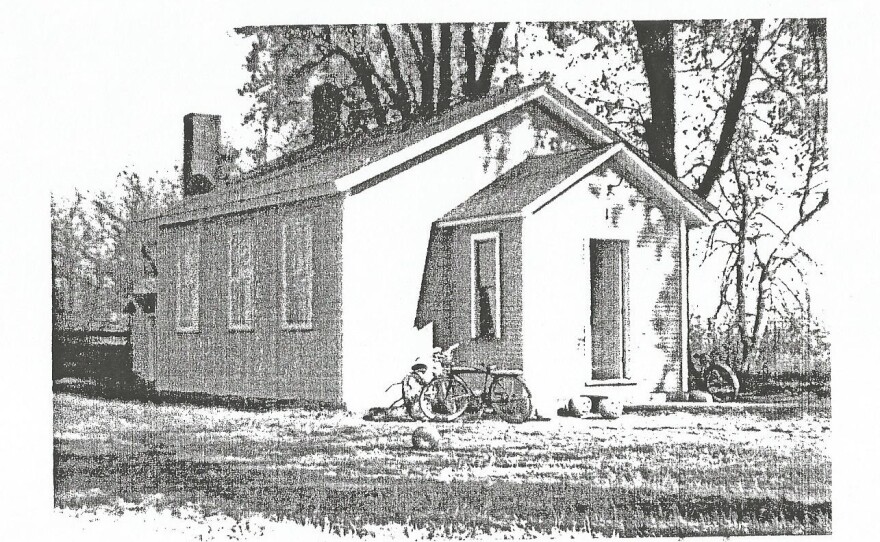


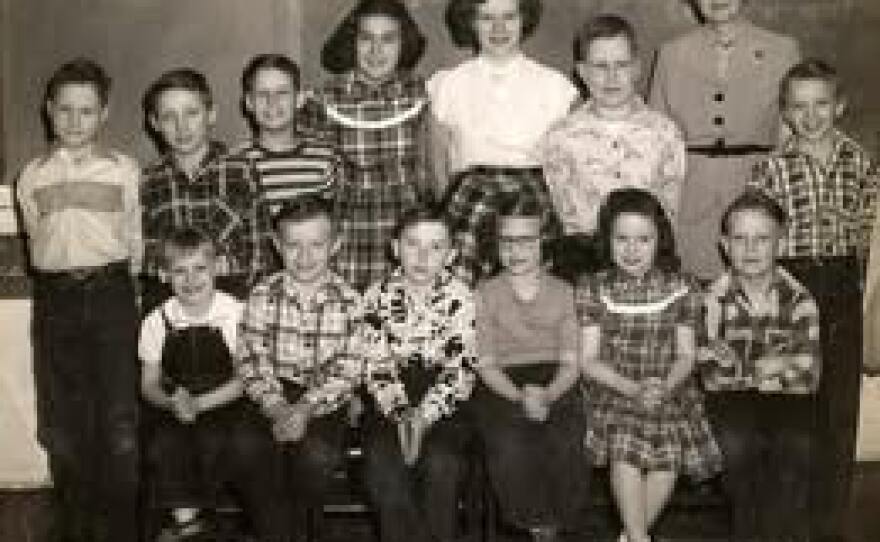
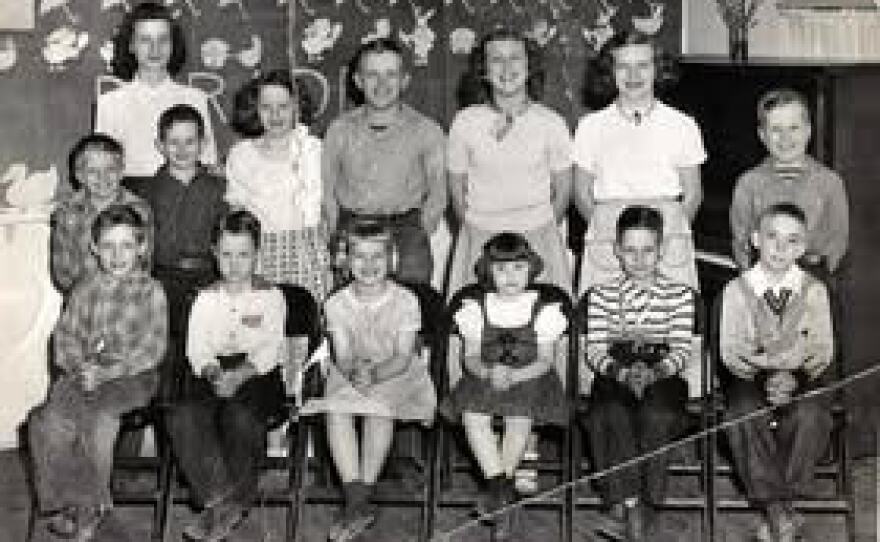


Back in the day, long before yellow buses rattled down rural roads, much of the schooling in Warren County happened in humble one-room buildings scattered across the countryside.
In 1854, a small village was laid out amid rolling farmland in Warren County. In 1866, just a dozen years after the town of Kirkwood (then called Young America) was founded, the village’s “official” school was built. It was called the “Old South School”.
But beyond the village, 1878-era records show that rural Warren County was dotted with dozens of these “country schools” One room, wood framed — serving farming families spread across the countryside. By some counts, there were well over a hundred ungraded schoolhouses in the county. Inside one of those country schools, a single teacher would ring a bell to start class, gather students around a pot-bellied stove for warmth in winter, call out spelling lessons or arithmetic problems, lead recitations of history or scripture.
The Old South School hosted spelling bees, evening programs, and town gatherings. The one room serving as Kirkwood’s classroom, meeting hall, and social center all at once.
As Kirkwood grew with the railroad arriving, new families settled in and the tiny building couldn’t keep up. By the late 19th century, larger and more modern school facilities appeared, eventually replacing the original one-room schoolhouse. But that first little building on the south side of town lit the spark. It taught the first generations of Kirkwood’s students and set the foundation for the strong community the village is known for today.
In 1908 alone, Illinois still had over 10,000 rural one-room schools. These buildings remain a powerful symbol of simpler times: of multi-age classrooms, impromptu recess in open fields, community gatherings, holidays marked with potluck dinners, and a shared dedication to learning.
Galesburg - Brick City USA

You can't go far in Galesburg without walking or driving on a Purington Paver brick. But the town was built on thick prairie dirt... and through much of the 1800s, every rain turned dusty streets to impassable mud.
Fortunately, below that prairie soil lay thick beds of clay. In 1849, the first brickmaker, German immigrant Henry Grosscup, bought land just east of Galesburg from Knox College. He then sold bricks to the college for its new buildings. The first of many brick streets in Galesburg was laid in 1884.
In 1890, Grosscup's property became the home of Purington Brick Company. Its namesake product, the hefty Paver, measured 4 by 4 by 8 inches and
weighed close to ten pounds. At its peak, Purington fired more than 150,000 bricks a day, in
ovens that covered 300 acres.
By the mid 20th century, however, road builders switched to asphalt. The company closed in the 1970s,but not before billions of Purington Pavers had shipped worldwide, from
Chicago to Paris... Panama City to Bombay, India... and Galesburg had laid over sixty miles of brick on every major street in town.
This episode was written by Peter Bailley with help from Barbara Schock.
Quackscam Fest

“The Great Raid of Dec. 3rd, 1980,” was the event that led to the arrest of 30 men who were charged with poaching in Browning, Illinois. Only one of these hunters went to prison, but many suffered fines and lost access to hunting licenses.
The event shocked and aroused the area. MOST felt it was an intrusion on a way of life that had been present since the first people arrived in the region. So, Browning organized the Quackscam Festival.
The first annual Quackscam festival was held on Saturday, October 3rd, 1981. Quackscam was an all day event that featured a parade, food vendors, a carnival, a duck calling contest, bale bucking, bingo, and a crowning of “Little Miss Browning” contest. These events changed throughout the years. The last Quackscam Festival was held on October 3rd, 1992; and after eleven years the festival was disbanded.
Nevertheless, the event is still widely discussed and part of the local lore. Even today, one might see an old Quackscam trophy in someone’s home or even a copy of the Quackscam game. Hunting and fishing is still a way of life for the people of Browning, IL, and of course it is all done legally.
This episode was written by Emma Weber of Rushville Industry High School
The Elephant's Graveyard.

A myth about where elephants go to die. A metaphor for a place where people or things are forgotten or lost.
Draw a line through Illinois from Monmouth to Oquawka and just maybe you've found that mythical place. Or part of it.
Elephants wander in and out of American history. Jefferson hoped to find them west of the Missouri. There were none. The King of Siam offered Lincoln elephants. Lincoln said no.
Nizie was a male dwarf Indian elephant. Magic brought him to Monmouth. The magic of The Great Nicola, a renowned traveling magician who made Monmouth his home when he was not on the stages of the world. A gift from an Indian prince, Nizie was part of Nicola's traveling magical menagerie. Nizie grew ill in 1934, came to Monmouth for care but died in the fall and was buried forgotten in a pasture.
Norma Jean was a large African elephant and main attraction of the Clark and Walter Circus. She was beloved for her gentle nature. In July of 1972, tragedy and lightning struck Norma Jean. The circus left hurriedly. Due to her size, Norma Jean was buried by the town where she fell. A search for Nizie's grave a few years ago may have found it.
Norma Jean's grave is marked and celebrated by the town still.
This edition was written by Joel Ward
SOURCES
Jefferson's Old Bones
https://www.americanscientist.org/article/jeffersons-old-bones
Lincoln to Thai king: Thanks but no thanks for the elephants
https://www.sj-r.com/story/news/2018/04/01/lincoln-to-thai-king-thanks/12849296007/
Nizie the Elephant
https://www.wchistorymuseum.com/nizie-the-elephant.html
Norma Jean, we hardly knew ye
https://www.peoriamagazine.com/article/norma-jean-we-hardly-knew-ye/
Norma Jean, Elephant Killed By Lightning
https://www.roadsideamerica.com/story/3619
Burlington Inventors


Cross-breeding of animals and plants was a significant hobby for early Burlingtonians – especially the wealthy. Think apples from James Grimes and Charles Mason. Or how about horses from the younger Charles Perkins?
But inventions became even more laudable. The most notable names in this category are Robert Noyce and Wallace Carothers. Both were born in Burlington but, by school age, their families had moved on to other Iowa cities. Burlington claims them anyway.
For Robert Noyce, think integrated circuits and silicon microchips. Following those developments, he co-founded Intel. His nickname says it all: “The Mayor of Silicon Valley.”
Wallace Carothers, on the other hand, was a chemist. At DuPont, his work was with polymers and, by 1939, women were able to switch from silk stockings to nylon stockings – thanks to Wallace Carothers.
This episode was written by Mark Krohlow
Canton's Pickle Sorting Machine
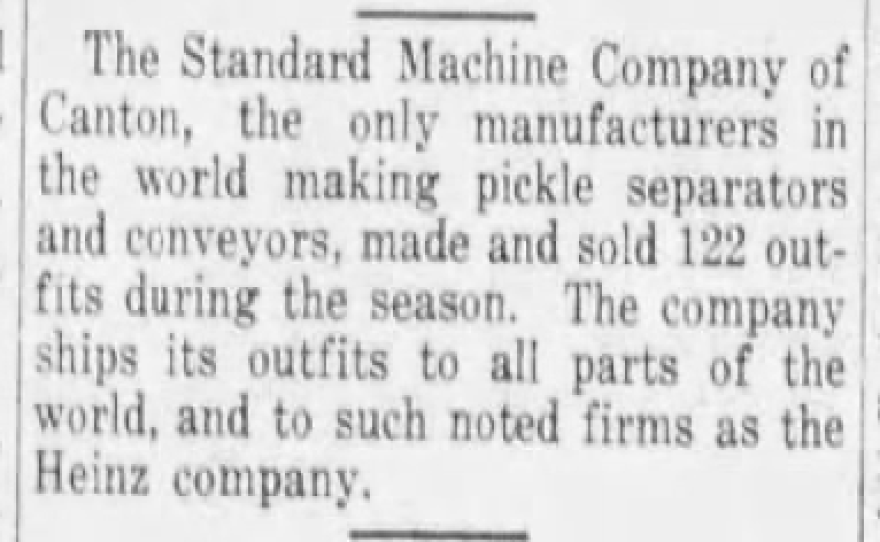


Canton Missouri has been a great friend to the pickle. Companies like Heinz had marketed them since the 1870s and demand boomed as the country grew. “Pickles Pickles Pickles! We want to contract for more pickles!” screamed a large ad for the Canton Pickle Co. in 1900. Area suppliers literally couldn’t get them out the door fast enough. Some Canton entrepreneurs determined to change that.
Among the more than 7 million patents filed during the 20th century was number 1190067, “the National Pickle Sorter” developed by Standard Machine Co, in 1916. Brothers J.C., J.A., and H.H. Zenge along with their partner T.C. Yeager, conjured a pickle-grading machine enabling rapid and accurate sorting, noting in the application “The invention aims to provide novel means for initially sorting the pickles, and to provide a cooperating means adapted to separate the sorted masses of pickles from each other as they drop downwardly.”
Demand was almost immediate. Standard Machine shipped twenty across the Midwest in the first year. Within a decade they produced fifty, aided by the National Pickle Factory Association of America’s official recommendation.
The nation’s appetite for canned food soared due to improvements like heat sealing and demand caused by World War One. Feeding soldiers and civilians was crucial to both morale and victory and was now needed on an immense scale. Such improvements in industrial canning helped make perishable food available like never before.
Standard Machine Company changed America’s canning industry, making it easier for farmers and suppliers to provide cucumbers, brought canned pickles to more people at home and abroad, and helped feed our soldiers.
In time, other companies and other inventions replaced Standard Machine and its National Sorter. The factory closed in the 1980s, its building on Lewis Street was destroyed by fire in 2013, and today few seem to know about Canton’s important pickle sorter. But for a time in the 20th century it taught the world a lot about the Art of the Dill.
This episode was written by Scott Giltner.
Hotel Nauvoo


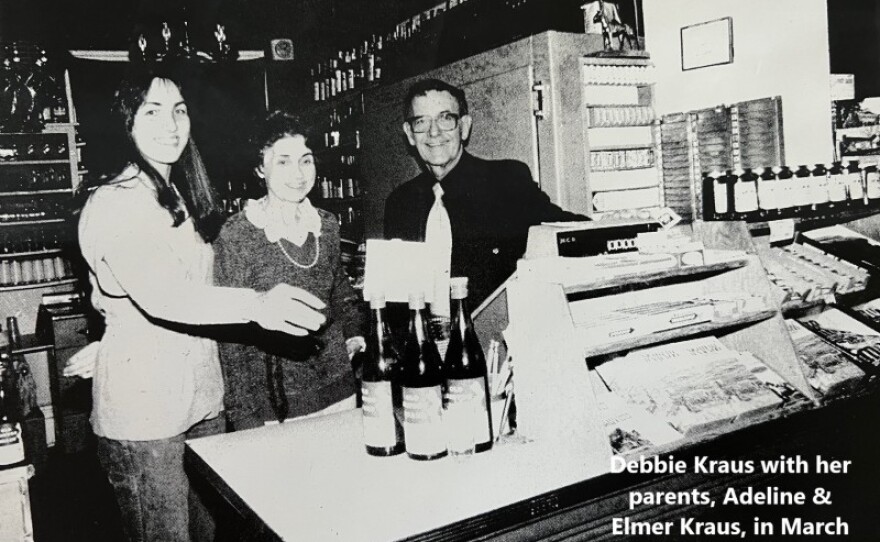

When you mention Nauvoo today most people will think of Hotel Nauvoo the world famous buffet that is a Nauvoo tradition. The original building was built as a residence in 1841, but in 1885 William Riembold purchased the home and converted the property to the Oriental Hotel adding nine rooms for guests. William and his wife ran the hotel until
1940 and then the building was vacant for a number of years. In 1948 John A. Kraus bought the dilapidated structure and after returning the building to its former glory he opened Hotel Nauvoo with buffet and restaurant on the first floor and rooms upstairs. In 1961 the building next door was connected to add more dining area, and 1968 had another dining room built on. Today the buffet is still serving food like it did in 1948 and is still owned by the Kruas family.
The Kraus Family made the decision to close the hotel and restaurant after this episode was written and recorded.
This episode was written by Rebecca Williamson.
Lincoln's Wrestling Matches

It is a fact that Abraham Lincoln is in the National Wrestling Hall of Fame because of his victory against the bully of New Salem … Jack Armstrong. It is also said that Lincoln only lost one wrestling match in the twelve years of his youth when he partook in the sport. And did you know the only match he lost was in Schuyler County, IL, and in fact, he may have lost twice?
In 1832 at the beginning of the Black Hawk War, 23 year old Capt. Lincoln led his men into camp just north of Rushville. After a dispute over a bivouac site, it was decided that Lincoln and Dow Thompson would “wrassle” for the right to camp. Lincoln said, “I then realized from his grip that for the first time that he was a powerful man and that I would have no easy job. The struggle was a severe one, but after many passes and efforts he threw me.”
Furthermore, according to William L. Wilson, a volunteer from Rushville, he and Lincoln also engaged in a wrestling match.
In 1882, Wilson wrote to the Adjutant General of Illinois and recalled the days of the Black Hawk War, “I have during that time had much fun with the afterward to be President of the United States ... I remember one time wrestling with him.Two best in three, and ditched him.”
If we are to believe Wilson then Lincoln was defeated twice and both losses were in Schuyler County.
This episode was written by Brian Schmidt
WSBV Radio and Clyde Hendricks

In the mid 1920’s Maquon had “radio fever.” WSBV, a radio broadcasting station, was operated by Clyde Hendrix in 1925 and
1926 from his cream testing station located on East Third Street in Maquon. If not the first, WSBV was one of the earliest radio stations in Knox County. The call letters stood for World’s Smallest Broadcasting Village. As promoter and operator, Clyde announced, “This is Station WSBV, world’s smallest broadcasting village, located on the banks of old Spoon River, where the bandstand stands in the middle of the town, the hard road runs all the way ‘round; everyone lives in the 100 block and your dog’s no better than mine.” Telephone requests came in for Ruth “Sugar” Forquer and her ukulele, and for the Selby sisters, Helen and Grace, who sang. Others wanted to hear Raymond Housh play his fiddle or listen to Harold Allen and Charlie Tomlinson, who were good on the mouth organ or jew’s harp. Anyone with a talent was welcomed, including Clyde’s hound dogs, always on hand to do their bit.
This episode was written by Kenny Knox.
Keokuk Armory Fire

Just after 9:30 PM on Thanksgiving Eve 1965, an explosion and flash fire tore through the National Guard Armory, where families had gathered for a night of square dancing. The blast collapsed the roof, trapping many inside. Seven died that night, over fifty were injured—some hospitalized for months. The final death toll reached twenty one.
Nearby residents rushed to help. Local medical workers treated the injured, contractors brought equipment, and the community rallied to donate blood, time, and labor in response to the tragedy.
Beyond local aid, people across the country—and even abroad—offered support. Patients were flown out for specialized care, news coverage spread far and wide, and donations came from places as far as Germany and Australia. Square dance clubs across the country reached out to help the victims and their families.
Investigators later determined the explosion was caused by a broken pipe leaking natural gas which was then ignited by a water heater.
As time passed, survivors began returning home, forever changed by the events of November 24, 1965—a day remembered for both its tragedy and the remarkable unity it inspired.
This episode was written by Angela Gates of the Keokuk History Center.
Christopher Columbus Clark

In Canton Missouri’s Forest Grove Cemetery, just off of highway 61, can be found the grave of Civil War veteran Christopher Columbus Clark, a man with some pretty surprising historical connections.
Born in 1846, Columbus Clark was raised in Canton. His mother Elizabeth Davis was cousin to Jefferson Davis. At 18, Unionist Clark enlisted in the 69th Enrolled Missouri Militia, formed in response to Confederate raids by guerilla commander Joseph Porter, serving as a private through portions of 1864 and 1865.
After the war he married Susan Overall, born the daughter of a minor slaveholder in Kentucky, and they had five children. Later, Columbus moved to Kansas to live with his daughter Gabriella, her husband Harry Armour and his granddaughter Ruth. Ruth married Ralph Dunham and had a grandson, Stanley Dunham. Columbus would pass away in 1937 at age 91 and was returned to Canton for burial.
Stanley Dunham married his sweetheart Maddie Payne in 1940. Maddie gave birth to a daughter named Stanley Ann, (known as Ann), in Wichita. In the late 1950s the Dunhams moved to Hawaii where Stanley got a job at a furniture store. In 1960, Ann Dunham met her future husband, a University of Hawaii student named Barack Obama, with whom she had a son born August 4, 1961 that you may have heard of.
So in Canton Missouri’s Forest Grove cemetery lay Civil War veteran Columbus Clark, cousin to the President of the Confederacy and 3rd great grandfather to the 44th President of the United States. Those relationships are a reminder that history connections are everywhere you look, even in small town Northeast Missouri next to the old Pizza Hut.
Born in Monmouth, Bound for Legend, Wyatt Earp

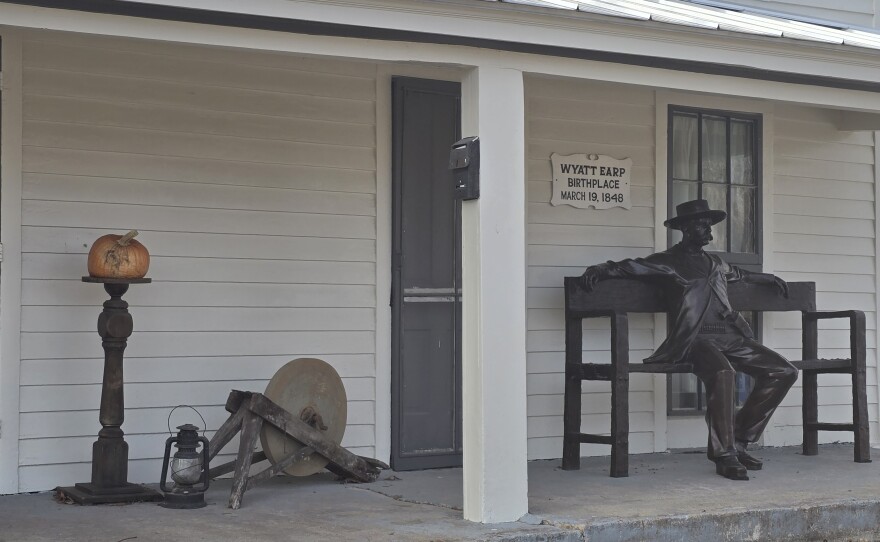

In the quiet heart of Monmouth, Illinois, stands a modest white house with green shutters. It’s the Pike-Sheldon House. At first glance, it looks like any other 19th-century home, but in 1848, it became the birthplace of one of America’s most legendary lawmen: Wyatt Earp.
Before the dusty streets of Dodge City and the gunfight at the O.K. Corral made him a frontier icon, Wyatt Berry Stapp Earp was just a boy growing up among the rolling prairies of western Illinois. His family’s home right in Monmouth still stands as one of the few places where visitors can literally walk in the footsteps of the man who would help define the Wild West. Wyatt Earp is a Monmouth son of the Heartland who became a national figure for his role in taming western frontier towns.
The Pike-Sheldon House isn’t just a birthplace, it is a time capsule. Its simple wooden frame has seen the growth of a nation, the movement of pioneers, and the rise of a legend whose name would echo from Illinois to Arizona and beyond.
Today, Monmouth honors that connection. It is a small Midwestern town that helped shape a larger-than-life American story. The Wyatt Earp Birthplace draws visitors, historians, and Old West enthusiasts from across the country.
Often heroes of the Wild West came from small, hardworking Midwestern communities. Because before he was a lawman and a legend, Wyatt Earp was one of Monmouth’s own.
The episode was written by Ann Tenold
Oldest Continuous Pharmacy in the Nation?


In 1834 Dr. J.B. Clarke opened a drug store on the north corner of the west side of the public square in Rushville, IL. This location has been a “drug store” ever since.
In 1838, Clarke sold out to James G. McCreery, who continued the site's tradition until his retirement in 1883. It was then sold to Isaac N. Vedder. The Vedders ran the store until 1955 when it was sold to Clark Moreland. In 1960, Clark’s brother-in-law, William Devitt, purchased half the interest. Ever since the store has been known as Moreland and Devitt.
The original building was a log cabin and thereafter a one-story frame building was constructed. The cabin was moved to Monroe Street and eventually a frame home was built around it. In 1976, the home was torn down and still inside was the old “drug store” log cabin. The frame building survived until 1904, when Emma Vedder had the building torn down and a massive two-story brick building built. It still stands on the west side of the public square where Congress and Washington Street intersect.
Current owner, Garry Moreland, has researched the topic, and cannot find an older continuous site in the nation. Therefore, Rushville can claim the title as having the oldest continuous “drug store” in the nation.
This episode was written by Brian Schmidt.
When Grocery Stores Were Scandalous

Today, the term _grocery_ has a quaint, small-town ring. It's often paired with the word _neighborhood_. But in the 1800s, grocery also meant liquor store. Controversial.
In the Lincoln-Douglas Debates of 1858, Stephen Douglas referred to Abraham Lincoln as a -- quote -- flourishing grocery-keeper in
the town of Salem. Lincoln recognized an insult, and he replied that he had -- quote -- never kept a grocery anywhere in the world.
Although Galesburg was founded by anti-liquor fundamentalists, by the 1880s the city had 22 grocery stores. There were also 15 saloons, then known as sample rooms, that served liquor by the drink. Respectable women didn’t go into saloons, but from the grocer or druggist they could purchase concoctions such as Hostetter’s Bitters or Lydia Pinkham’s Vegetable Compound. These alcohol–based patent medicines were unregulated, widely advertised, and relatively inexpensive.
After prohibition ended in 1933, the word saloon faded from use, in favor of uptown terms such as tavern or cocktail lounge, and a grocery was something everybody wanted in their neighborhood.
This episode was written by Peter Bailey with help from Barbara Schock
Joseph Smith Homestead

In the spring of 1805 William Ewing set out to set up a trading post for the US Indian Affairs office. He cut down several oak trees on the peninsula that is now called Nauvoo and built a two story block house by May of 1805. Ewing managed the post for a short period of time, but it was closed due to mismanagement. A series of Indian Agents came through to open the trading post for short periods of time, but by 1810 the building sat abandoned and vacant. In 1824 Captain James White purchased the land and cabin and reopened the trading post. On May 10, 1839 Joseph Smith and his wife Emma would move into this log cabin after purchasing it from Captain White. This building still stands today and is called the Joseph Smith Homestead. Joseph expanded it several times for his growing family and growing church needs. Today the building is owned by The Church of Jesus Christ of Latter-day Saints and is open for tours.
This episode was written by Rebecca Williamson
Billy Sunday

Without a doubt, Burlington lived up to the reputation of river towns. The refined class was eclipsed by the ruffian class. Vast quantities of alcohol resulted in frequent brawls and even in shots being fired.
In 1905, Burlington was ripe for an appearance by Billy Sunday, the most notable evangelist of the time. In preparation, a temporary tabernacle was built. It seated four thousand, was 163 by 69 feet, and required forty wagon loads of sawdust to serve as the three-inch-thick floor. Because the five-week revival was to be in November and December, six stoves were placed inside for heating.
Billy Sunday had already made a name for himself as a professional baseball player. Playing initially for Chicago, he was reputed to be the fastest man in the National League – circling the bases in 14 seconds.
After his 1886 conversion, Billy went on the evangelism trail. Pulpit acrobatics served him well. Favored targets were the “red-nosed, buttermilk-eyed, beetle-browed, peanut-brained, saloon-keepers,” quoted the Burlington Gazette. One day, with a few free hours, he acted as timekeeper at a Burlington-Winfield football game. When a scuffle broke out, he quelled it by “flinging men right and left.”
The revival was a success with 2,500 people being converted. Records don’t show how many stuck with the conversion.
This Episode was written by Mary Krohlow.
Caroline Grote

No woman shaped Western Illinois University’s early years more than Caroline Grote. Born in 1863, she spent 56 years in education, breaking barriers as Illinois’ first female county superintendent.
In 1906, when Bayliss was president of Western Illinois State Teachers College, he hired Carolyn Grote to train school teachers. But she also advocated for improving conditions in rural schools. In one report, she noted that many schools had windows that “were seldom washed,” and outhouses that were deplorable. School libraries were often inadequate and not suited to the needs of the students.
Grote’s career took a new turn in 1908 when she became the Dean of Women and supervised the women students. One rule she upheld was that “every modern girl should have a chaperone.”
Even at 69, Caroline Grote never stopped learning, earning a doctorate from Columbia University. She retired in 1935, and to honor her impact, WIU renamed Monroe Hall to Grote Hall, ensuring her legacy lives on.
This episode was written by Sue Scott.
Keokuk Breweries
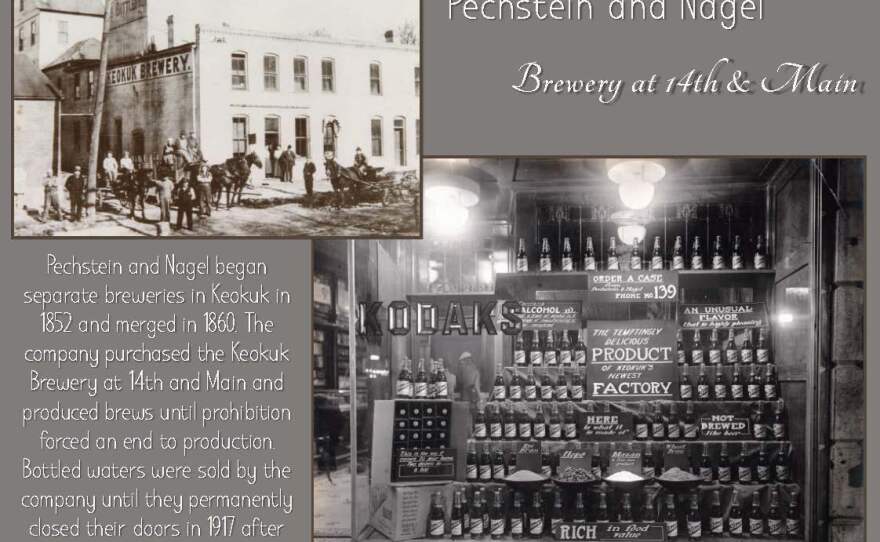

In 1973, the discovery of caverns beneath a yard on Plank Road in Keokuk brought to light the town’s rich history of beer and whiskey production.
Around 150 years ago, Keokuk had five breweries and seven distilleries. Keokuk’s first brewery was built in 1850 between 12th and 13th on Main Street. It was owned by William Schowalter. Joseph Kurtz would begin brewing at this location after taking over in 1855. He called it “City Brewery” and moved the operation to 19th and Plank Road by 1861. The Leisy Brewing Company was an impressive-looking operation along the riverfront in West K and Pechstein and Nagel’s Keokuk Brewery occupied the north side of the 1400 block of Main Street. They operated until January 1, 1916 when Prohibition was enacted in Iowa. Other breweries in Keokuk’s history included Kennedy and Vockrodt Ale, Eagle Brewery, Mississippi Brewery, Peter Haubert Brewery, Frederick Letterer, and F. W. Anschutz. Distilleries included Martin Keating, N. Leonard and Company, John S. McCoy, and Stannus and Evans.
Saloons promoted locally produced beer and whiskey, and beer gardens featured musical talents to attract patrons who would enjoy Keokuk’s brews.
Fires wiped out many breweries and by 1900, only two remained. When those remaining operations closed, so did a chapter in Keokuk’s manufacturing history.
This episode was written and voiced by Angela Gates of the Keokuk History Center.
Poe ain't comin'


"Poe ain't comin'."
That's what they might have said in 1849 in Oquawka, Illinois.
Edgar Allan Poe had already made "The Raven" croak and "The Tell-Tale Heart" beat by 1848 but the Mississippi River town of Oquawka, Illinois, wanted Poe not for his poems and tales but for his fame as an editor and the prestige Poe would bring to the new Oquawka Spectator.
Twenty year-old Edwin Patterson, son of The Spectator's founder, was a Poe fan. Patterson wrote Poe in December, 1848, inviting him to the edge of the Midwest and the beginning of the West. Poe could make The Spectator the literary heart of the nation, Patterson hoped. Oquawka had high hopes for itself too. Civic pride and boosterism were bulwarks of 19th century small town presses.
The life of a magazine editor in 19th Century America could be prestigious as well as precarious. The toast of a town or the nation one moment or falling deeper than the House of Usher the next. Patterson and Poe corresponded for months, with varying degrees of enthusiasm on the part of Poe.
Finally, circumstances intervened. Patterson waited for a letter that never came. Edgar Allan Poe died under strange circumstances in October, 1849. Poe was 40 years old.
Patterson soon caught the gold bug and left for California. The Spectator continued publication until 1908.
This edition was written by Joel Ward and voiced by Joel Ward.
SOURCES
Might Edgar Allan Poe have made Oquawka a literary hub?
Jeff Rankin
https://jeffrankin.medium.com/might-edgar-allan-poe-have-made-oquawka-a-literary-hub-6ea6e8c31091
What if Edgar Allan Poe had moved to Oquawka?
Rex Cherrington
https://www.thezephyr.com/poequawka.htm
IMAGES
Edgar Allen Poe
https://en.wikipedia.org/wiki/Edgar_Allan_Poe
Edgar Allen Poe
Encyclopedia Britannica
https://cdn.britannica.com/52/76652-050-F4A6B093/Edgar-Allan-Poe.jpg
River Scene, Oquawka Illinois
Henderson County Library
https://www.hendersoncolibrary.com/oquawka/mississippi-river/
W.A. Sheaffer and the Birth of an Iconic Pen Company


In 1907, a Fort Madison jeweler named Walter A. Sheaffer revolutionized the way people wrote. Frustrated with the messy and inconvenient fountain pens of the time, Sheaffer invented a self-filling pen using a lever system—eliminating the need for separate ink bottles. With just $35 and an idea, he filed a patent and set out to change the writing world.
By 1912, Sheaffer Pen Company was officially founded right here in Fort Madison. What started in the back of his jewelry store quickly grew into a global brand. Sheaffer pens became known for their craftsmanship, innovation, and reliability—earning a reputation that made them a favorite among writers, business leaders, and even U.S. presidents.
For nearly a century, Fort Madison was home to the world headquarters of Sheaffer Pen Company. Though production has moved, the legacy of W.A. Sheaffer lives on. His innovation didn’t just put Fort Madison on the map—it made an indelible mark on history, one signature at a time.
Episode was written by: James Lemberger
Monmouth Western Stoneware Company



Welcome to Monmouth, Illinois, where a quiet patch of land once hid a discovery that would help shape an American industry. In the 1850s, as farmers tilled the soil, and more railroad tracks began laying west, a treasure beneath their feet was discovered. It’s not gold, not silver, but clay. And not just any clay. This was a rich, remarkably workable deposit perfect for pottery and stoneware.
Local entrepreneurs quickly realized what they were standing on. Word spread, kilns were built, and before long Monmouth became a hot spot for high-quality clay products. But the real breakthrough came in 1906, when several regional potteries joined forces. Their merger formed a name that would become legendary in American ceramics: Western Stoneware Company.
Western Stoneware wasn’t just making jugs and crocks. Potters were crafting the everyday vessels that fed America: butter churns, food storage jars, water coolers, and later, decorative pieces that collectors now hunt for like buried treasure.
And it all started with those extraordinary Monmouth clay beds. Raw material that ignited a company, fueled a region, and left its mark in every beautifully glazed piece of Western Stoneware.
Episode written by Ann Tenold
Virginia “Jennie” Scripps


Eliza Virginia Scripps or Miss Jennie as she was known, was born on October 10th,1852, in Rushville, IL. While her older siblings were off starting and running newspapers all over the United States, Miss Jennie remained in Rushville, caring for her parents and their farm. She remained on the homestead until her parents passed and fire destroyed the original home in 1897. She then moved to California, but also bought a home in Rushville on West Lafayette which still stands today and is the home of the author's grandparents.
Her commitments to the town are still recognized today. In 1909, she had the Episcopal Church built in remembrance of her father; and Scripps Park was created from the Scripps Homestead, which she had turned over to the city of Rushville to be used for a park or recreation. Her sister, Ellen Browning Scripps, celebrated Miss Jennie by having The Virginia (a replica of the original home) constructed near the original site.
Miss Jennie’s kindness and dedication left a lasting mark on her hometown of Rushville. She gave back to the community creating landmarks and spaces still respected today. She died in London, on April 28,1921, and is buried in Rushville.
Episode written by Reed Fretueg, Rushville Industry High School Student
How Loraine, Illinois got it's name

The town of Loraine was started in 1870 on the Carthage branch of the Chicago, Burlington, and Quincy Railroad. Like many small towns in Western Illinois at that time, it was started as the result of the railroad coming through the prairie. Anthony Pitzger Lionberger worked for the CB&Q railroad and helped put the railroad line through the area that became Loraine. The residents admired Anthony so much that they named the town after his daughter Loraine who was two at the time. In August of 1873, at the age of 40 after jumping off a train onto a railroad spike, Anthony sadly passed away from blood poisoning. Little Loraine lived a long full life eventually passing away in 1952 at the age of 83. Anthony Pitzger Lionberger is my 3 times great Uncle.
Episode written by: Rebecca Williamson
The Pearl Button Capitol of the World


Walk around the riverfront in places like Canton Missouri these days and you can still find peculiar little shells, polished smooth, with several small holes cut in them. Younger people are puzzled but older folks know them as relics of a once powerful industry and of an age before modern plastics when freshwater mussels were central to the region’s economy.
In the early 1900s, this part of the Mississippi was the “pearl button capital of the world”. The largest producer, the Hawkeye Pearl button factory in Muscatine Iowa, specialized in mother-of-pearl buttons and other pearl novelties, producing at its peak a staggering 1.5 million mother-of-pearl buttons a year.
Clammers collected mussels and worked in camps along the river to open them and remove the meat and pearls. In cutting plants in Canton, Keokuk, and Oskaloosa the raw shells were processed. Some cut the shells into squares, while others polished, drilled the holes, or machined decorative designs. At its peak, the Hawkeye Pearl Button Factory had more than 800 employees.
Eventually, as Mississippi mussels were fished to scarcity, zippers and other closures became more popular, and mass-produced plastic buttons came to dominate, the pearl button trade died out. Canton’s Hawkeye Pearl button factory closed in 1960. The last Muscatine pearl button was produced in 1967. Today a 28 foot tall statue of a clammer stands in Muscatine as tribute to the workers who built what was once a $1 million a year industry at a time when more than a third of the world’s buttons came from our area.
Episode written by Scott Giltner
The Naming of Burlington, Iowa

Other than the fur traders who reaped untold riches in their trade with the Fox and Indians, it was 1832 when the earliest settlers were allowed west of the Mississippi. The area which would become Burlington became a popular site. In 1833 streets were being laid out. John B. Gray bought one of the first lots and opened the first grocery store. He also acquired naming rights and settled on Burlington - in honor of his Vermont home town. Prior to the official naming, the area had been known as Shoquoquon - meaning Flint Hills.
Then in 1859, several Wisconsin and Burlington people became part of the Colorado gold rush. There were Alonzo Allen and Henry Dickens, George and Morse Coffin, and the Beckwith family. They settled along St. Vrain Creek. Some panned for gold – others chose farming. By 1962, a name was needed so that a post office could be established. It became Burlington – this time in honor of Burlington, Iowa. Despite high hopes for the settlement – flooding became an issue – just as at home. There remains an Old Burlington Cemetery, but most residents moved to nearby Longmont.
Episode written by Mary Krohlow